

Archive

May 20, 2026

Browsing

The post AI Coins Rally Hard As SERV, BNKR, VVV Jump appeared first on Coinpedia Fintech News

AI coins are ripping again, and no, this isn’t one of those overnight “next big thing” rotations the market forgets in 48 hours. The AI narrative has been grinding higher for months now, and today’s leaderboard is packed with tokens riding that momentum hard.

OpenServ’s token, SERV, surged roughly 27% intraday after the project pushed out a fresh claim tied to Google’s newly released Gemini 3.5 Flash model. According to OpenServ, its SERV engine paired with DeepSeek v4 Flash can outperform Google’s setup at nearly one-thirtieth of the cost. Cheap, faster, “enterprise-ready” AI infrastructure? Crypto traders eat that stuff up like it’s free yield season again.

SERV Momentum Keeps Getting More Aggressive

Well, here’s the kicker. Today’s candle wasn’t built in isolation. The daily chart shows SERV has been climbing steadily since early May, with cumulative gains now approaching 350%.

Price action also reflects growing momentum around AI infrastructure narratives tied to governments, Fortune 500 firms, and high-stakes operational systems. Whether those adoption dreams materialize is another conversation entirely, but traders clearly aren’t waiting around for audited quarterly reports.

Meanwhile, the broader AI coin sector remains one of the strongest-performing corners of the market today.

BNKR Buyers Extend Early May Breakout

BankrCoin’s token BNKR also joined the rally, climbing 28% intraday and extending its already strong upward trend from earlier this month.

The move places BNKR among the top-performing AI-related assets on LunarCrush’s intraday rankings. Short-term charts show continued speculative demand flowing into lower-cap AI names as traders rotate away from slower large-cap plays.

But let’s be real momentum like this cuts both ways. These rallies tend to move vertically until they don’t.

Robinhood Listing Pushes VVV Even Higher

Then there’s Venice Token, better known as VVV, which gained another 22% after becoming available for trading on Robinhood. That listing catalyst added fresh retail visibility at a time when AI-linked crypto assets are already dominating social and trading feeds.
So, what’s next? If AI narratives continue sucking liquidity into the sector, SERV, BNKR, and VVV crypto could remain market favorites in the near term. But if momentum cools, traders chasing green candles late may quickly discover how brutal AI coin reversals can get.
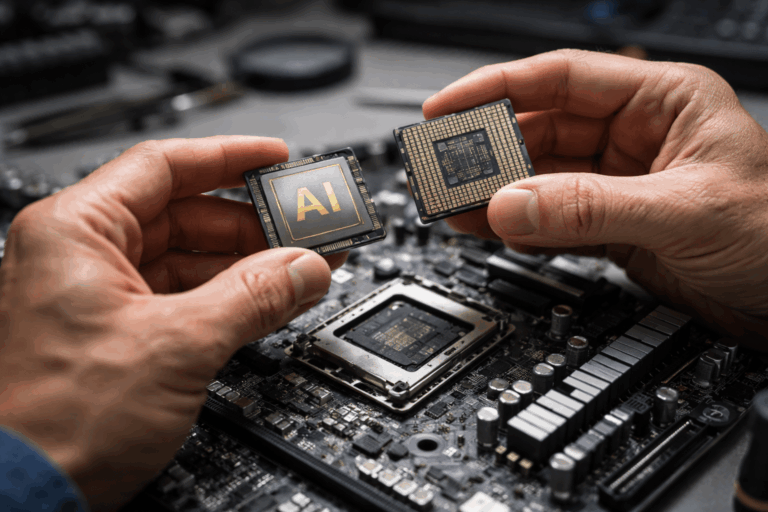
The global semiconductor landscape is bracing for impact as Nvidia (NVDA) prepares to report its fiscal first-quarter 2027 financial results tonight after the closing bell.

Wall Street’s consensus is hovering at a breathtaking bar, with analysts projecting a non-GAAP profit of $1.78 per share on record revenue of $79.2 billion.

Achieving these figures would represent an explosive year-over-year revenue expansion of roughly 79.5%, a testament to the unyielding appetite for artificial intelligence infrastructure.

However, this print has transcended being a standalone corporate milestone; it acts as the definitive macro bellwether for the tech sector.

Because Nvidia sits at the apex of advanced computing, its forward-looking guidance and supply chain updates will inevitably dictate the trading momentum and strategic valuations of its closest rivals, Advanced Micro Devices (AMD) and Intel (INTC).

The AMD readout: checking the depth for the challenger’s moat

For Advanced Micro Devices, Nvidia’s report is a double-edged sword that provides crucial validation for its own aggressive AI roadmap.

Having recently posted a blockbuster forecast pointing to $11.2 billion in second-quarter revenue, AMD has proven that it is the primary challenger to Nvidia’s crown.

Tonight, investors will dissect Nvidia’s Blackwell architecture ramp to gauge whether demand continues to outstrip supply, leaving a massive secondary spillover market for AMD’s MI350 and MI400 accelerators.

If Nvidia notes any deceleration in enterprise capital expenditures or hardware digest periods, multiple compression will swiftly hit AMD stock.

Conversely, if Nvidia underlines a structural supply deficit, it signals to hyperscalers that they must diversify their pipelines, validating AMD’s push to secure market share in data center inference workloads.

Heading into Nvidia’s release, Wall Street has a consensus “strong buy” rating on AMD stock with price targets going as high as $625, indicating significant further upside room through the year-end.

AMD shares gained 8% on Wednesday.

The Intel equation: server CPU traction and foundry foundations

Intel views Nvidia’s earnings through a profoundly structural lens, particularly following its own robust first-quarter turnaround, which yielded a 22% spike in Data Center and AI (DCAI) revenue.

Intel’s server chips, like the Xeon 6, are increasingly vital because they act as the host CPUs embedded directly inside Nvidia’s massive DGX Rubin NVL8 systems.

A blowout quarter for Nvidia fundamentally guarantees an immediate volume pull-through for Intel’s processor divisions.

Furthermore, as Intel aggressively markets its Gaudi 3 accelerators as cost-effective alternatives and seeks to scale its external foundry business toward a $15 billion pipeline, Nvidia’s data will confirm whether the broader market’s “unprecedented demand for silicon” remains intact.

Any macroeconomic cooling revealed tonight could stall Intel’s complex structural turnaround before its 18A manufacturing node hits high-volume production.

Heading into Nvidia’s quarterly print, Wall Street rates Intel shares at “hold” only – with the mean price target of nearly $85 signaling potential “downside” of nearly 30% from here.  

Intel shares were up 5% in the trading session.

The post Why Nvidia earnings are particularly significant for Intel, AMD stock appeared first on Invezz