Archive

July 2026

Browsing

The satirical news site The Onion isn’t waiting to take possession of Infowars to launch a parody of Alex Jones ’ conspiracy platform.

More than a year after first trying to buy Infowars, The Onion on Thursday will debut a send-up under its own website with plans to give some of the revenue to families of the victims in the Sandy Hook Elementary School shooting.

The families have still received no money from Jones since courts ordered him to pay more than $1 billion for falsely calling the 2012 shooting a hoax.

The Onion will start by sending the families $100,000 from merchandise sales that combine the conspiracy empire’s brand with the The Onion’s logo in rainbow colors, according to CEO Ben Collins, whose company is still in court trying to take control of Infowars.

“Don’t give comedy writers a grudge for 18 months,” Collins said.

The parody will include a series of shows and other content under Infowars branding that spoof Jones’ aggressive mashup of conspiracies linking major news events, dubious scientific claims, attacks on people suffering in tragedies and sales of supplements and survival gear.

Alex Jones in Houston in 2024.David J. Phillip / AP file

Jones’ claims that the 2012 shooting that killed 20 first graders and six adults at Sandy Hook Elementary School in Connecticut is a hoax have no truth, but Jones continued to amplify them. His followers started to harass victims’ families, suggesting they were “crisis actors” and even making death threats.

Jones’ Infowars empire had 10 million visitors a month and generated more than $50 million in annual revenues at its peak, according to the company. But the $1.4 billion judgments in defamation cases in Connecticut and Texas, where Jones is based, forced him into bankruptcy and broke Infowars apart.

“All he’s been left with is an iPhone and a fancy microphone,” said Chris Mattei, an attorney for nine of the Sandy Hook families.

Jones has moved his show to a different website. An email sent to an address to request interviews went unanswered.

The families knew they could never stop Jones from getting his message out, and he has managed to avoid paying the judgment so far. But they could expose what he said and assure he can never profit again, Mattei said.

“Every dime Alex Jones makes from here until the end of eternity is going to be claimed by the families,” Mattei said.

The Onion stepped in when Collins saw Infowars’ assets were going to be sold at auction.

Collins spoke to Sandy Hook families, who said they were briefly skeptical, but then saw how The Onion’s staff could use the Infowars style and branding to take the moral high ground and make fun of the people who not only caused them so much pain but they felt also poisoned society.

Collins didn’t want to give away too much of the new stuff before it goes live Thursday.

But the new Infowars will maintain The Onion’s sharp satire sprinkled with shock value. Collins said there will be a section selling a penis flattening device, a fake “pro oxygen” supplement pill that the host claims can replace breathing, as well as an extended debate on how many Bozo the Clowns there are.

“It’s old-fashioned Infowars — using the tricks that they use to get people addicted to outrage and, I would say, addicted to anticipation, trying to find the thing that’s around the corner that’s going to save your life,” Collins said.

The Onion will keep chasing Jones’ property. Collins thinks they will soon get control of the Austin, Texas, studio Infowars once used.

Some families can’t wait for that day. Collins said that Robbie Parker, whose daughter died at Sandy Hook, plans to read his book about fighting Jones while dealing with so much grief in the place Jones once sat.

The families at first wanted Infowars shut down forever and Jones never heard from again. But they are now looking forward to seeing what The Onion has planned, attorney Mattei said.

“The idea that it could be turned to some social good. I think it’s even better,” Mattei said. “So, yeah, I think the families are both pleased and amused with what they’ve been able to achieve here.”

All eyes are on Terawulf (WULF) shares this morning after the digital infrastructure firm revealed a monumental $19 billion contracted revenue deal with Anthropic.

But it’s not all about WULF only; neocloud provider IREN Ltd (IREN) is soaring this morning as well, and it also has the same artificial intelligence (AI) research lab to thank.

Despite today’s gains, however, IREN shares are hovering just over the price at which they started 2026.

Here’s why IREN stock is soaring on Monday

The primary catalyst fueling IREN stock at writing is the revelation that the company has been shortlisted for Anthropic’s massive, confidential data center procurement project in Australia.

According to reports from The Australian Financial Review’s Street Talk column, the high-profile AI lab behind the Claude family of LLMs wants to secure a whopping 1.4 gigawatts of operational capacity in a regional expansion valued between $12 billion and $15 billion.

Being named an elite bidder alongside institutional real estate giants like AirTrunk and NextDC heavily validates IREN’s rapid pivot into high-performance computing (HPC).

This validation is further amplified today by a broader tech sector rebound – with Nasdaq futures gaining over 1.1% to lift high-beta AI growth names across the board.

IREN shares to benefit from enterprise contracts

The structural implications of Anthropic’s multi-billion-dollar tender transform IREN’s long-term commercial outlook as it positions the company to lock in highly lucrative, multi-decade enterprise hosting contracts.

It also sharpens investor focus on IREN’s balance‑sheet discipline and its ability to scale without diluting shareholders.

A bid of this magnitude signals that IREN’s modular HPC architecture, renewable‑heavy power strategy, and accelerated commissioning timelines meet the technical and operational thresholds demanded by frontier‑model developers.

Just being in the final cohort improves IREN shares’ credibility with hyperscalers, strengthens its negotiating leverage for future enterprise contracts, and broadens the probability for long‑duration, inflation‑protected revenue streams that could reshape its valuation trajectory.

How Wall Street recommends playing IREN Ltd

As regular trading progresses, the dual announcements from TeraWulf and IREN clearly signal that frontier AI enterprises are looking past traditional hyperscalers to secure raw, grid-allocated power.

Anthropic’s multi-billion-dollar infrastructure commitments prove that AI capital expenditures are being distributed across multiple agile infrastructure providers rather than a single winner-take-all monopoly.

For IREN stock, transitioning its massive 5-gigawatt secured power pipeline into multi-decade enterprise hosting leases completely reshapes its forward-looking revenue predictability heading into the upcoming August earnings cycle.

While execution risks regarding capital dilution remain a standard talking point on Wall Street, the mid-summer market price action demonstrates that institutional investors are aggressively buying the dip on verified megawatt ownership.

Note that Wall Street currently has a “Moderate Buy” rating on IREN Ltd, with a mean price target of nearly $81.

The post It's not just Terawulf, IREN shares are soaring because of Anthropic too appeared first on Invezz

The post LAB Price Explodes 150% As Short Sellers Get Steamrolled appeared first on Coinpedia Fintech News

The LAB price just reminded the market why low-float assets and leveraged traders are a dangerous combination. After sweeping liquidity below the critical $7.49 support and plunging as low as $5.50, the token suddenly reversed course and ripped more than 150% higher in a single day. Crypto traders love calling tops. Markets love proving them …

The artificial intelligence boom has a people problem, and it is getting worse faster than most investors have noticed.

While Wall Street has spent the better part of three years fixating on chip stocks, hyperscaler spending, and the relentless march of AI valuations, a less glamorous drama has been unfolding in suburban town halls, county commission meetings, and online petitions from New Jersey to Michigan.

Ordinary Americans, armed with electricity bills, noise complaints, and a generalised anxiety about what artificial intelligence is doing to their lives, are pushing back against the physical infrastructure of the AI boom — and they are beginning to win.

In the first quarter of 2026, 75 data-centre projects worth a combined $130 billion were blocked or delayed by local opposition, according to Data Center Watch, a research firm backed by AI security company 10a Labs.

That is as many projects as faced that fate across the entirety of 2025.

The pace of resistance is accelerating precisely as the pace of construction is accelerating, creating a collision that the industry has been slow to take seriously.

Why communities are saying no

The grievances are varied, but they cluster around a handful of recurring concerns.

Power consumption sits at the top. Between 2018 and 2023, the share of total US electricity consumption represented by data centres rose from 1.9% to 4.4%, according to a study published in the journal Environmental Research Letters.

Projections for what comes next are stark: by the end of the decade, national average wholesale electricity costs could rise between 6% and 29%, with the increase driven primarily by data-centre expansion.

In Virginia, one of the epicentres of the country’s data-centre boom, electricity generation costs could spike by as much as 57%.

Water usage is a second flashpoint.

Data centres use enormous volumes of water for cooling, and in communities already managing drought risk or ageing infrastructure, the addition of a facility consuming millions of gallons annually is not an abstraction.

Residents have also cited the constant low-frequency hum emitted by large facilities, which critics argue could fundamentally alter the character of surrounding neighbourhoods and pose health concerns with prolonged exposure.

Then there is something harder to quantify but no less real.

A general psychological resistance to artificial intelligence has fused with the more concrete grievances, giving the movement an ideological dimension that purely economic arguments cannot easily address.

About 44% of Americans now oppose data-centre construction in the United States, against just 21% who support it, according to a Reuters/Ipsos poll conducted in June.

The gap widens sharply when the question becomes personal: asked whether they would support a data centre in their own community, 57% said no, while only 14% said yes.

“Something that has changed right now is that now we have people that are against data centres even though they don’t have a data centre in their backyard, because they see data centres as the embodiment of AI,” Miquel Vila, lead analyst at Data Center Watch, told Fortune.

“What they oppose is AI. They consider that stopping data centres is the way to stop AI development.”

Why Wall Street is beginning to pay attention to the protests

To appreciate why the financial stakes are significant, it helps to understand how thoroughly the data-centre buildout has underpinned the broader economy and equity markets.

Morgan Stanley estimates that hyperscalers like Microsoft, Amazon, Alphabet, and others will spend $800 billion on capital expenditures in 2026 — roughly the same amount that all non-technology S&P 500 companies combined spent on capex in 2025.

The Semiconductor Industry Association projects that government and industry will spend a further $4 trillion on data-centre infrastructure through 2028.

Data-centre construction spending has already topped $50 billion in a single month, surpassing total US public spending on transportation infrastructure including airports and subways, as Bloomberg reported.

AI enthusiasm has been almost entirely responsible for the S&P 500’s 84% rise since ChatGPT’s public launch in November 2022.

Goldman Sachs expects the AI investment theme to account for roughly half of all earnings growth over the next two years.

The lofty valuations of companies across the AI supply chain rest, to a significant degree, on the assumption that planned capacity will materialise.

A large portion of it may not.

“A lot of the commitments and the build-out of data centers where it’s easy has kind of been done, so you’re getting marginally more difficult,” said Todd Castagno, a managing director at Morgan Stanley in a New York Times report.

“From a markets perspective, expectations might be, maybe not reset, but realigned with the fact that it’s hard to put a couple trillion dollars in the ground in a short time.”

Cities including Tulsa, New Orleans, Birmingham and Ypsilanti Township in Michigan have implemented temporary bans on permitting or construction, as have dozens of other counties and towns, according to a database maintained by hedge fund Interconnected Capital.

Democrats and Republicans in 14 states have proposed construction pauses.

Maine’s legislature passed a temporary statewide moratorium in April, though it was subsequently vetoed by Governor Janet Mills.

Why the tech industry’s charm offensive may not be enough

The technology industry has responded with a concerted public relations effort.

Late last year, Meta spent more than $6 million on an advertising campaign across eight states and Washington DC, promoting the economic benefits of data centres to local communities.

OpenAI and Microsoft have publicly pledged to absorb the energy costs their facilities generate, a gesture aimed at defusing consumer anxiety about rising electricity bills.

Nvidia, Amazon, and Google have each announced technological advances they claim will significantly reduce data-centre water consumption.

Whether any of this is sufficient is genuinely unclear.

“The AI boom is fast approaching a moment of truth, as rapid growth and soaring valuations collide with ballooning capital expenditure, a public backlash and the challenges of real-life adoption,” Deutsche Bank analyst Cox wrote in a recent report.

The resistance, as Vila and others have noted, is no longer purely local.

It has taken on the character of a broader social movement, and social movements are not easily neutralised by folksy advertising.

Analysts debate magnitude of risk to AI-related stocks

For investors, the distribution of risk matters as much as its existence.

“Data-centre opposition is more of an emerging risk than an immediate pressure on AI-related stocks,” Gil Luria, head of technology research at DA Davidson, said in a Barron’s report.

The largest hyperscalers — Microsoft, Google, Amazon — have global footprints and enough redundancy to route investment around hostile localities. They are inconvenienced, not threatened.

The same cannot be said for smaller operators dependent on a handful of large projects.

“The smaller AI clouds are small enough, and have projects that are big enough, that losing a few projects is material,” Luria says.

CoreWeave, for instance, is facing organised resistance to a proposed facility in Kenilworth, New Jersey, that would draw 250 megawatts of electrical capacity — roughly a quarter of the company’s active capacity today.

An online petition calling for the project’s cancellation has gathered more than 11,000 signatures.

Logan Purk, a technology industry analyst at Edward Jones, believes that already extended construction timelines will lengthen further, ultimately reducing the total amount of capacity built.

The ripple effects would travel up the supply chain. “I do think the difficulty is not fully baked in,” Purk said in a New York Times report.

“If we assume tomorrow that data-centre construction stops because there’s no access to new power, the ripple effects across the semiconductor industry would be pretty substantial.”

The picks-and-shovels companies — the equipment and infrastructure suppliers whose fortunes are pegged to the volume of construction — are the most directly exposed.

The resistance might also create some winners

The backlash, however, is not without its beneficiaries.

Mark Guberti of The Motley Fool argues that operators who already have data centres built and generating revenue are quietly positioned to benefit.

“The presence of fewer data centers helps these companies charge higher prices for their AI infrastructure,” he says.

Among the names he points to are Iren and Terawulf, both of which have operational sites and a revenue base that a construction freeze would only make more valuable.

Edge data centres represent a separate category of potential winner.

“These types of data centers are much smaller than large-scale AI data centers that eat up multiple gigawatts of energy,” Guberti says.

“Protesters are less likely to rally against these types of data centers, and zoning requirements for them are less complex.”

These facilities consume far less power and water, present a significantly smaller target for organised opposition, and are considerably less likely to trigger the kind of community mobilisation that is stalling larger projects.

One Stop Solutions, which designs the hardware that forms the backbone of edge data-centre sites, is among the companies analysts have identified as a direct beneficiary of that shift.

Honeywell offers exposure to the same theme through its building automation division.

The business grew 8% year over year in the fourth quarter and accounted for roughly a fifth of the company’s total sales.

However, Honeywell is diversified across multiple industrial businesses, making it a less concentrated play on the edge data-centre theme than One Stop Solutions, which carries more risk but offers purer exposure for investors seeking growth.

The post Americans' revolt against data centers is growing: how it could disrupt the AI trade appeared first on Invezz


The post Stellar (XLM) Price Prediction for 2026, 2030: Is a Structural Breakout Ahead? appeared first on Coinpedia Fintech News

Story Highlights The live price of the Stellar crypto is If payment adoption and tokenization expand, Stellar could trend toward $2.50 by 2026 and potentially $5–$7 by 2030 in a strong cycle. Stellar has entered 2026 at a critical inflection point, with price stabilizing after a prolonged downtrend while attempting to build a base near …

US stock funds saw their biggest weekly exit since March, raising fresh questions about the strength of Wall Street’s rally.

Investors pulled $17.2 billion from US stock funds in the week through July 1, according to Bloomberg, citing Bank of America strategists led by Michael Hartnett and EPFR Global data.

The move does not signal a market crash, but it does show investors are turning more cautious after a strong run in US equities.

The key question now is simple: is this routine profit-taking, or an early warning that confidence in the AI-led rally is starting to fade?

Wall Street’s rally loses its flow cushion

Fund flows work like a sentiment gauge as they show whether investors are adding fresh money to equity funds or quietly taking some risk off the table.

A $17.2 billion weekly exit does not mean the S&P 500 is collapsing, but it indicates that investors are becoming more cautious after a powerful run in US equities.

That matters because this rally has leaned heavily on megacap technology, AI optimism and confidence that corporate earnings can keep absorbing higher rates.

When money is still pouring in, expensive markets can keep climbing, but when flows turn patchier, valuations become more exposed to bad news.

The shift did not appear from nowhere as US equity funds already saw $3.5 billion of outflows in the week to June 24, as worries over debt-funded technology spending and hawkish Federal Reserve expectations weighed on sentiment.

Technology sector funds saw nearly $20 billion of withdrawals that week, reversing the previous week’s inflows.

That makes the latest BofA number less of a surprise and more of a continuation and a signal that investors are no longer buying every dip with the same confidence.

Tech fatigue is becoming harder to ignore

The pressure point remains technology. The AI trade has been the engine of Wall Street’s advance, but it is also where concentration risk is highest.

The MSCI World Index fell 2.07% last week amid worries over concentration risks and hyperscalers’ spending plans.

Those concerns matter because investors are watching whether cloud giants can turn massive AI capex into durable profits, not just bigger bills.

BNY’s Bob Savage told Reuters that the AI-led equity rally was showing signs of fatigue.

That is the kind of line that lands because it captures the market’s current mood: still bullish on AI in principle, but less willing to ignore every valuation warning.

Oliver Shale, investment specialist for the US at Ruffer, made the positioning risk clearer.

He said that through the lens of valuations, positioning and sentiment, risk measures are “flashing amber.”

Rotation, not full retreat

The more balanced reading is that investors are rotating, not giving up on equities altogether.

LSEG data showed global equity funds pulled in $10.4 billion in the week to July 1. Asian equity funds attracted $7 billion, their biggest inflow in seven weeks, while US funds saw a smaller $1 billion inflow.

Technology funds also rebounded with $8.9 billion in inflows after the previous week’s heavy selling.

That complicates the bearish case. Investors may be trimming crowded US exposure while still buying technology and other regional equity opportunities.

William Bratton, head of cash equity research for APAC at BNP Paribas, struck that tone in a note cited by Reuters.

He said the bank’s tech analysts saw “no reason” for the sector’s earnings momentum to slow or reverse in the near term, with the coming second-quarter earnings season expected to be supportive.

The post US stocks see biggest exit since March: is Wall Street’s rally at risk? appeared first on Invezz

The post India’s RBI Wants Banks To Stay Away From Crypto, Even Ready To Ban It! appeared first on Coinpedia Fintech News

The Indian government, which collected nearly ₹18.38 lakh crore (around $193.5 billion) in tax revenue during the 2025-26 financial year, is set to isolate banks from crypto.  India’s biggest bank, the Reserve Bank of India (RBI), has proposed its ‘containment’ approach to cryptocurrencies, aiming to keep banks away from crypto transactions and private stablecoins while …

Europe’s benchmark STOXX 600 index climbed to a record high of 653.19 on Friday before easing to trade around 652.66, putting it on track for its biggest weekly gain in more than a month.

European equities are drawing a more constructive read from Wall Street, with several major brokerages revising their targets upward in recent weeks.

But the upgrades come loaded with caveats, and the gap between improving economic signals and stretched valuations is keeping even the bulls from going all in.

A Goldilocks moment, with reservations

Bank of America on Friday raised its year-end target for Europe’s STOXX 600 index to 630 from its previous forecast of 590.

The bank cited an improving euro zone growth outlook as the energy shock triggered by the Iran conflict fades and German fiscal stimulus begins to filter through to economic activity.

The bank’s economists expect euro area domestic demand growth to reaccelerate through year-end, supported by a less hawkish European Central Bank and easing inflation pressures.

Data released this week gave that view some empirical grounding.

Euro zone inflation rose less than expected in June, while S&P Global’s latest survey showed overall business activity moved out of contraction territory in June for the first time since March.

Bank of America described the current environment as a “mini-Goldilocks moment” — economic activity rebounding while price pressures moderate.

Yet the firm stopped well short of a full endorsement.

It retained its underweight rating on Europe relative to global equities.

“We remain negative on European equities despite a more constructive euro area growth outlook: the European market remains priced for perfection,” BofA strategist Sebastian Raedler said.

BofA expects the index to dip to 595 by early in the fourth quarter, weighed down by rich valuations, a potential slowdown in AI-driven market momentum, and rising credit risks, before recovering toward its year-end target.

JP Morgan and Barclays have made similar upward revisions in recent weeks, with Barclays also dropping its previously bearish stance on the region.

Where the rally could broaden

UBS analysts offered a more textured take earlier this week, arguing that Europe’s AI-focused rally has room to extend beyond technology into industrial and luxury stocks.

Re-shoring of industrial capability, government spending programmes, and brightening economic conditions will help a wider pool of companies participate, they said.

European industrials currently trade at a discount to their US peers, but the analysts expect momentum from electrification and the AI data-centre buildout to help close that gap.

Stabilising demand for luxury goods should support a rebound in that sector as well, with German fiscal spending providing an additional tailwind for domestic stocks.

BofA had also separately upgraded the United Kingdom to overweight from marketweight, while maintaining an overweight stance on Germany, saying both markets appear overly pessimistically priced relative to their underlying economic outlooks.

“While we remain neutral on European equities overall, the case for selective exposure remains strong,” UBS said.

An earnings recovery built on a narrow base

The near-term earnings picture adds another layer of complexity.

Companies in the STOXX 600 are forecast to post average earnings growth of 14.5% in the second quarter, according to London Stock Exchange Group IBES data — a headline figure that looks encouraging until it is disaggregated.

Exclude the energy sector, and profit growth falls to 5.5%, revealing how heavily the region’s earnings recovery depends on a jump in oil and gas company profits.

That concentration makes the broader market more vulnerable to any reversal in energy prices than the top-line number suggests.

Taken together, the analyst consensus points to a European equity market at an inflection point — improving fundamentals, selective opportunities in industrials, luxury and the UK and Germany, but valuations that leave little margin for error and an earnings base that is narrower than it appears.

The post Stoxx 600 hits record high: BofA raises year-end target to 630 appeared first on Invezz

The post Is the Worldcoin Price Ready for a Reversal? WLD Rebounds After 40% Drop but Bulls Remain Uncertain appeared first on Coinpedia Fintech News

Worldcoin price underwent a strong rebound from the local lows before hitting the strong support zone between $0.32 and $0.33. The price has surged significantly but is currently facing a small correction of over 3.34%, reaching $0.385, while volume has increased by over 52%. The token is attempting to rebound from a crucial demand zone …

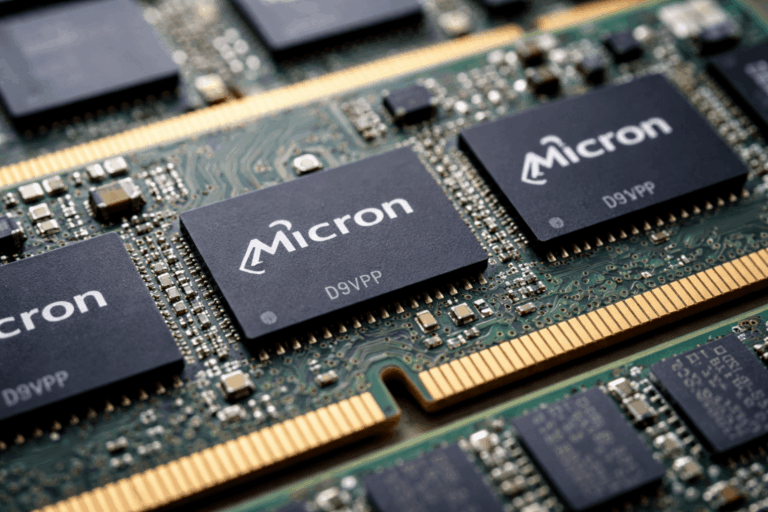
Micron Technology (MU) shares extended their recent decline on Thursday, falling 4% after tumbling 10% in the previous session, as broader weakness across technology stocks continued to weigh on semiconductor names.

The latest decline came despite public praise from President Donald Trump and a bullish outlook from Mizuho Securities, highlighting how investors remained focused on the broader selloff in high-growth technology stocks.

Micron shares have still posted exceptional gains this year, rising 219% in 2026 despite the recent pullback.

Tech selloff overshadows Trump’s endorsement

Earlier this week, Micron announced a $250 million investment in Trump Accounts, tax-advantaged savings accounts for children under the age of 18.

Under the program, children born between 2025 and 2028 will receive a $1,000 deposit from the US Treasury Department.

Following the announcement, President Donald Trump praised the company in a post on Truth Social.

“Micron, a truly GREAT American Company, and one of the ‘HOTTEST’ anywhere in the World, has announced a HISTORIC $250 MILLION Investment in TRUMP ACCOUNTS,” Trump wrote.

Despite the endorsement, Micron shares continued to decline as investors rotated out of semiconductor stocks.

The weakness was part of a broader technology selloff that has affected many of the year’s strongest performers.

Global semiconductor weakness pressures memory stocks

The pressure on Micron coincided with a sharp decline in South Korea’s stock market, where technology shares led losses.

South Korea’s KOSPI index dropped 7.9% on Thursday as the technology selloff spread beyond US markets.

Major memory chip manufacturers SK Hynix and Samsung Electronics, two of Micron’s largest competitors, declined 14.6% and 9.1%, respectively.

Although the selloff has been significant, both Micron and the broader South Korean market have delivered strong gains this year.

The KOSPI remains up 81% in 2026, compared with a 9.3% gain for the S&P 500 over the same period.

Mizuho maintains bullish long-term outlook

Despite the recent volatility, Mizuho Securities continues to view Micron as its preferred investment among leading semiconductor companies.

Mizuho Securities put out its top picks for July on Thursday which featured Robinhood and Oracle.

Analyst Vijay Rakesh maintained an Outperform rating on the stock with a price target of $1,375.

According to Mizuho, Micron delivered its strongest quarterly stock performance on record during the second quarter, with shares gaining 242%, even though the stock declined following its third-quarter earnings report.

Rakesh said demand for memory products is expected to remain strong through 2027, supported by continued investment in artificial intelligence infrastructure.

“We see MU and other key memory suppliers all seeing strong near-term tailwinds, driven mostly by AI demand,” Rakesh wrote.

He also said Micron is expected to remain a “key winner” in the memory semiconductor industry.

The recent pullback underscores the volatility surrounding semiconductor stocks after a powerful rally earlier this year.

While investors have taken profits across the technology sector, analysts continue to point to long-term demand for AI-related memory products as a supportive factor for Micron’s business outlook.

The post Micron stock extends decline despite Trump's praise and bullish analyst views appeared first on Invezz