Archive

May 2026

Browsing

The post BGB Price Climbs as Bitget Pushes Fresh Trading Incentives appeared first on Coinpedia Fintech News

The BGB price is showing signs of life again after spending months under pressure, with the token gaining nearly 7% intraday as renewed trading activity returns to the Bitget ecosystem. For much of the first half of 2026, BGB struggled to maintain momentum as broader market conditions weighed on exchange tokens. However, the decline appears …

The KOSPI Index has entered the longest bull market in decades. After bottoming at KRW 2,132 in 2022, it has jumped by 295% to the current KRW 8,476. It has jumped by 100% this year and by 215% in the last 12 months. So, the question is whether the blue-chip index will continue the bull run and hit KRW 10,000 or retreat?

KOSPI Index has jumped because of the AI boom

The ongoing Kospi Composite Index surge has been driven by the technology boom that has driven its top companies up by triple digits. Samsung Electronics has jumped by 163% this year and by 465% in the last 12 months. This rally has pushed its market capitalization to over $1.38 trillion.

Similarly, SK Hynix, a company that makes memory and other chips, has soared by 258% this year and by nearly 1,000% in the last 12 months. It has entered the exclusive $1 trillion market club as the growth gains steam.

Samsung and SK Hynix stocks have soared because of the ongoing AI boom that has pushed their revenues higher. For example, SK Hynix said that its revenue jumped by 60% QoQ and by 198% YoY to 52.58 trillion won in the first quarter, driven by DRAM and NAND volume and price surge. The company’s cash jumped to over 54.3 trillion KRW from 14.3 trillion KRW in the same period last year.

Other top companies in the index have also jumped this year. For example, LG Electronics stock has gone parabolic, moving to KRW 293,000, its highest level on record. It jumped by 315% in the last 12 months. Most of these gains accelerated last week after the company inked a partnership with Google.

Some of the other top gainers in the KOSPI Index are companies like LG CNS, LG Innotek, Solus Advanced Materials, Hyundai Autoever, and Doosan. 

The ongoing AI boom has led to the fear of missing out (FOMO) among market participants in the stock market. In most cases, when there is such a prolonged bull market, it is common for retail investors to buy. 

The rally, together with the falling South Korean won, has led to more demand from international investors. Recently, however, there are signs that these foreigners are dumping the shares.

Kospi Composite Index technical analysis

Kospi Index chart | Source: TradingView

The daily chart shows that the Kospi Index has been in a strong bull run this year, moving to a record high of KRW 8,476. It recently crossed the important resistance level at 8,036, its highest point on May 13.

The index has remained above all moving averages, while the Relative Strength Index (RSI) has continued rising. Therefore, based on trend-following principles, chances are that the index will continue rising, potentially to the key resistance level at KRW 10,000. 

In the long-term, however, there is a likelihood that the index will suffer a strong reversal as it moves to the distribution and markup phases of the Wyckoff Theory.

The post KOSPI Index at a crossroads: Can South Korea's bull run reach 10,000? appeared first on Invezz

The post Stellar (XLM) Price Cools After an 80% Rally—Consolidation Before the Next Breakout? appeared first on Coinpedia Fintech News

Stellar (XLM) is outperforming the crypto markets, posting an 80% move in a short time and a mammoth rise in trading volume. The token also outperformed Bitcoin (BTC), leading by a staggering 33.7% in indexed performance over the past 2 days. Moreover, the XLM price, recording yet another 22.85% jump in the past 24 hours, …

Major League Baseball owners made their long-expected salary cap proposal to the players’ association on Thursday, a system the union has vowed never to accept, setting the sides on course for a confrontation that threatens the 2027 season and perhaps beyond.

Baseball owners hadn’t proposed a firm cap since 1994. Their effort prompted a 7 1/2-month strike that forced the cancellation of the World Series for the first time in 90 years.

MLB’s proposal would cap spending in 2027 at $245.3 million, using figures for luxury tax payrolls that include benefits and the pre-arbitration bonus pool, and establish a payroll floor of $171.2 million. The Los Angeles Dodgers, baseball’s biggest spenders, had a $415.2 million payroll on opening day this year — around $170 million over the proposed cap.

Owners said they would discuss a phase-in schedule that would give teams like the Dodgers time to comply with the cap and an escrow system with the union as part of a proposed seven-year deal, that all current contracts would remain guaranteed and there would be no prohibition of guaranteed contracts under the cap system.

MLB said it would centralize local media revenue from the 30 teams equally and give players a 50-50 split as part of a proposal that would eliminate the current revenue-sharing plan among the clubs.

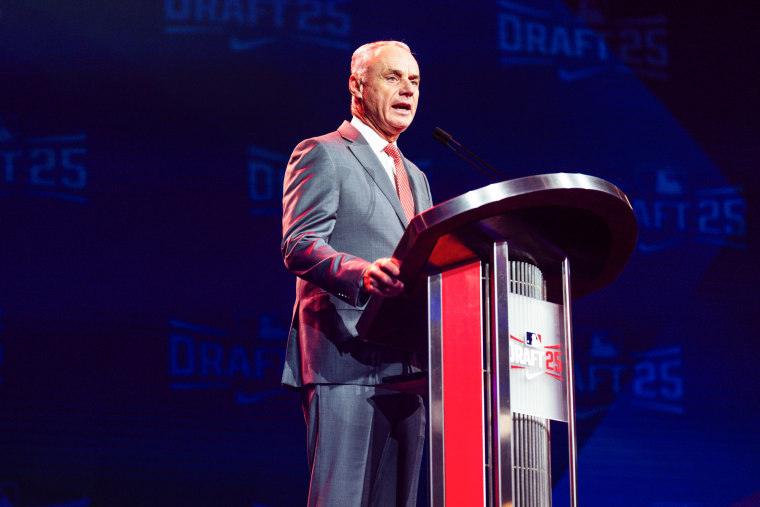
Major League Baseball Commissioner Rob Manfred.Matthew Grimes Jr. / Atlanta Braves via Getty Images file

“Our salary cap and floor proposal levels the playing field while sharing baseball revenue with the players 50/50 as we grow the game together,” MLB spokesman Glen Caplin said in a statement. “Further, by sharing media revenue equally as part of our proposal, we can address another top fan concern of local TV blackouts.”

Baseball’s current five-year deal, agreed to in March 2022 after a 99-day lockout, expires Dec. 2. While a lockout next winter is expected, talks are not likely to intensify until late February or early March 2027, when the possibilities of losing regular-season games and revenue near. If regular-season games are lost, negotiations may become a standoff of which side can tolerate the most economic loss.

Based on 2026 opening day figures, eight teams would have to cut payroll to get under the cap. The teams over are the two-time reigning World Series champion Dodgers, New York Mets ($379.2 million), New York Yankees ($339.6 million), Toronto ($319.5 million), Philadelphia ($315.2 million), Boston ($263.7 million), San Diego ($260.1 million) and Atlanta ($247.9 million).

Twelve teams would be required to increase payroll by a total of $617 million based on 2026 numbers: Miami ($81.8 million), Cleveland ($95.7 million), Tampa Bay ($108.2 million), the Chicago White Sox ($108.6 million), St. Louis ($114.4 million), Washington ($119.1 million), Pittsburgh ($122.6 million), Minnesota ($125.6 million), Milwaukee ($130.9 million), the Athletics ($139.2 million), Colorado ($142.2 million) and Cincinnati ($148.8 million).

Owners and the union agreed to a luxury tax in 2003 designed to slow spending, but teams feel it has had little or no impact on the Dodgers and Mets in recent years. The last small-market MLB club to win a World Series was Kansas City in 2015, although Cleveland, Tampa Bay and Milwaukee all lead their divisions as of Thursday, while the Mets and Red Sox are in last place.

MLB said its revenue has grown by 247% since 2003 and player payroll has increased by 149% in that span.

Management gave the union its latest plan during a bargaining session at the commissioner’s office, one day after the union made its economic proposal. Owners say a cap is needed to improve competitive balance and restrain wealthy teams from assembling starrier rosters than their smaller-market brethren.

Players want expanded free agency and salary arbitration rights along with almost doubling the major league minimum, increasing the money high-revenue teams share with the less-wealthy clubs and establishing penalties for teams that drop below payroll floors.

Aaron Judge of the U.S. leads teammates onto the field before game against Venezuela in the World Series of Baseball in Miami on March 17.Megan Briggs / Getty Images file

Other U.S. major sports leagues operate under a cap. The NBA had a cap in its initial season in 1946-47, then dropped that and began its modern version in 1984-85. NFL players and owners adopted a cap for the 1994 season, and the NHL did so in 2005-06 after a lockout wiped out the entire 2004-05 season.

The Dodgers shattered MLB’s spending record with a combined $515 million in payroll and luxury tax last year en route to their second straight World Series title. Los Angeles’ total was seven times the $68.7 million payroll of the Marlins, the lowest-spending team, and more than the payrolls of the bottom six clubs combined.

Players say a cap would hurt them and enrich owners, and they say they will never agree to one. Without a cap, MLB stars have landed lucrative, guaranteed contracts that outpace what the biggest stars in other U.S. sports leagues make. Juan Soto’s $765 million, 15-year contract with the Mets is believed to be the biggest ever in team sports and is far greater than the largest deals in the NFL (Patrick Mahomes at $450 million over 10 years) and NBA (Jayson Tatum at $314 million over five years).

MLB’s last salary cap proposal in 1994 offered players a 50-50 split of revenue in a system that would have forced teams to maintain payrolls of 84%-110% of the average. Salary arbitration would have been eliminated and the threshold for free agency would have been lowered from six years’ major league service to four — with the provision that a player’s former club could match any offer until he had six years.

MLB’s offer came on June 14 that year, and players struck on Aug. 12. MLB withdrew the cap proposal the following Feb. 6 after pressure by the National Labor Relations Board. The strike ended on March 31 after U.S. District Judge Sonia Sotomayor — now a Supreme Court justice — issued an injunction restoring the work rules of the expired labor contract. Two days later, owners accepted the union’s offer to return to work without an agreement. A deal wasn’t reached until 1997.

Stanley Druckenmiller just made a few portfolio moves that Wall Street is watching rather closely.

The billionaire founder of Duquesne Family Office – widely regarded as the most influential active money manager since Warren Buffett’s retirement – has completely exited his position in Alphabet and piled into five AI hardware stocks instead.

His latest 13F filing, covering holdings as of March 31st, reveals a bet on the physical infrastructure that powers artificial intelligence (AI), not the software giants who ride it.

Names Druckenmiller has invested in include SanDisk, Micron, Seagate, Broadcom, and Arm.

Why Druckenmiller walked away from Google stock

Duquesne has offloaded its entire stake in Alphabet, selling all 385,000 Class A shares worth nearly $153 million – a position the billionaire had just built up by 277% in the prior quarter.

The exit looks like disciplined profit-taking, given Google, in the two-plus quarters Druckenmiller held the stock, appreciated by more than 50%.

Following this surge, Google shares are trading at roughly 28x forward earnings, versus 17x only just a year ago.

Druckenmiller has also been openly skeptical about AI valuations – saying he believes “AI might be a little overhyped now” and that “AI could rhyme with the internet.”

And when the valuation no longer fits the thesis, the billionaire moves on – fast.

Why he loaded up on SanDisk stock

Duquesne opened a new position in SanDisk, buying 38,155 shares worth about $24.2 million – and the timing was exceptional.  

SNDK’s Q3 report was the giveaway; revenue hit $6 billion versus $4.7 billion estimates, up 251% year-over-year, with data center sales of $1.5 billion, up 645% year-over-year.

CEO David Goeckeler described the results as “a fundamental inflection point,” citing a structural shift toward AI inference workloads that demand high-speed NAND flash at scale.

With hyperscalers locking in multi-year supply agreements, SanDisk is no longer just a consumer storage brand – it has become a critical node in the AI infrastructure stack.

Why Micron shares are attractive for Druckenmiller

Druckenmiller’s bet on Micron stock may prove to be his sharpest call of the quarter.

Micron delivered Q2 revenue of $23.9 billion – a 196% increase year-over-year – cementing its position as one of the biggest beneficiaries of the AI boom.

The numbers didn’t just beat estimates – they demolished them. Earnings per share (EPS) came in at $12.07, far above the $9.33 consensus, while revenue exceeded forecasts by nearly $3.7 billion.

And the outlook is even more striking: for the current quarter, MU guided for about $33.5 billion in revenue, implying year-over-year growth of over 200%.

As CEO Sanjay Mehrotra put it, Micron is an essential AI enabler and the only US-based memory manufacturer – a strategic asset in a supply-constrained world.

His thesis on owning Seagate stock

Old-fashioned spinning hard drives sound like a strange AI play, but Druckenmiller saw something others missed; Duquesne bought 50,700 Seagate shares valued at about $19.9 million.

The thesis is playing out emphatically. Seagate’s Q3 delivered revenue of $3.1 billion – up 44% year-over-year, with adjusted earnings per share of $4.10 – far ahead of analyst expectations.

Better yet, demand visibility is “extraordinary”: nearline capacity is nearly fully allocated through calendar 2027, with build-to-order contracts being finalized through the end of fiscal 2027.

Moreover, the top three global cloud providers’ remaining purchase obligations nearly doubled to about $1.1 trillion; Seagate is essentially sold out well into next year.

Why Druckenmiller invested in Broadcom shares

Druckenmiller initiated a significant new stake in Broadcom, purchasing roughly 196,000 shares worth $60.7 million – the largest single new position in the batch.

Broadcom is the dominant designer of custom AI accelerators for hyperscalers like Google and Meta, offering a cost-effective alternative to Nvidia’s off-the-shelf GPUs.

Q1 AI revenue hit $8.4 billion, up 106% year-over-year, above the company’s own forecast – and the acceleration isn’t slowing: AVGO guided for AI semiconductor revenue of $10.7 billion in Q2, with total Q2 revenue expected to reach $22 billion, up 47% year-over-year.

CEO Hock Tan has stated plainly that AI revenue growth is accelerating, with the company eyeing $100 billion in cumulative AI-related sales by 2027.

Here’s why he bought ARM shares as well

Rounding out the five picks is Arm Holdings, the British chip-design firm whose instruction set architecture sits inside virtually every modern processor.

Duquesne opened a new position of 106,700 ARM shares worth about $16.1 million.

ARM is benefiting structurally from AI’s spread across every compute environment.

For the full fiscal year, Arm posted record revenue of $4.9 billion, with royalty revenue up 21% and licensing revenue up 25%, its third consecutive year of more than 20% revenue growth since going public.

Most tellingly, data center royalties more than doubled year-over-year as cloud companies increasingly turn to Arm-based custom chips.

With AI moving from training to inference at the edge and in data centers alike, Arm’s architecture is everywhere – and Druckenmiller is betting it stays that way.

The post Stanley Druckenmiller just sold Google shares to load up on five AI hardware stocks appeared first on Invezz


The post Morgan Stanley Buying XRP ETFs But Still Avoiding a Spot XRP ETF? appeared first on Coinpedia Fintech News

Banking giant with an AUM of $7.4 trillion, Morgan Stanley has quietly disclosed its XRP holding-linked exchange-traded funds, marking. While the holdings are relatively small, the disclosure is drawing attention because it comes as institutional interest in XRP products continues to grow and U.S.-listed XRP ETFs attract fresh investor inflows. Morgan Stanley Reports First XRP-Linked …

Shares of Autodesk ADSK fell sharply on Friday despite the company reporting stronger-than-expected quarterly earnings, as investors reacted cautiously to its planned $3.6 billion acquisition of maintenance software company MaintainX.

Autodesk stock dropped about 4% in trading to around $230 after the company announced the all-cash acquisition, its largest deal to date.

The decline extended the stock’s difficult year, with shares now down roughly 19% in 2026.

The selloff came even after Autodesk posted fiscal first-quarter adjusted earnings of $2.99 per share on revenue of $1.93 billion, beating analyst expectations of $2.84 per share and $1.89 billion in revenue.

The company also raised its full-year guidance for revenue and earnings.

MaintainX acquisition sparks valuation concerns

Investor attention quickly shifted from the earnings beat to Autodesk’s decision to acquire MaintainX, a maintenance and operations software platform focused on factory and facility management.

MaintainX expects to generate more than $135 million in annualized recurring revenue in 2026, with annual growth above 50%, according to Autodesk.

The acquisition is expected to expand Autodesk’s footprint beyond design and engineering into operations management, creating a new business unit called Autodesk Operations Solutions.

The division will combine MaintainX with products including Fusion Operations, Tandem, and Flexsim.

Chief Executive Andrew Anagnost said the deal is aimed at linking asset design and operation workflows more closely.

“Autodesk is expanding beyond design and make to operations, ensuring data and insights flow seamlessly in a continuous lifecycle,” Anagnost said in a statement. “Our goal with MaintainX is to bring deep operational expertise, contextual data, and workflows that enhance our ability to use AI to converge digital and physical worlds.”

Autodesk plans to fund the transaction with approximately $1.6 billion in cash and debt financing for the remainder.

The deal is expected to close before the end of Autodesk’s fiscal year in January 2027, pending regulatory approval.

Analysts remain positive despite investor skepticism

While investors reacted negatively to the size and valuation of the acquisition, several Wall Street analysts maintained bullish views on Autodesk shares.

BTIG analyst Nick Altmann estimated that the transaction values MaintainX at roughly 18 times expected 2027 revenue, representing a premium to many software peers at a time when sector valuation multiples have compressed.

Still, BTIG maintained a Buy rating and a $300 price target on Autodesk stock, arguing the acquisition strengthens Autodesk’s customer workflow positioning while adding valuable operational data useful for virtual modeling and AI applications.

Oppenheimer analyst Ken Wong also viewed the acquisition favorably, calling operations a “natural extension” of Autodesk’s role in the design and building process.

However, Wong acknowledged investor concerns surrounding execution risks and slowing organic growth.

“In addition to the price tag, investors are wary of potential organic growth moderation and execution risks as go-to-market synergies aren’t apparent,” Wong wrote in a note on Friday.

UBS similarly reiterated its Buy rating and $290 price target following the results.

The bank said Autodesk’s quarter likely exceeded expectations, especially amid fears the company could reduce guidance.

UBS also noted that the company has been improving execution as it completes ongoing go-to-market and business model changes.

AI and operations expansion drive long-term strategy

The MaintainX acquisition highlights Autodesk’s broader effort to position itself within AI-driven industrial software markets.

MaintainX’s software tracks work orders, inspection records, asset performance, and maintenance activity across factories and facilities.

Autodesk believes the operational data generated by the platform could support future AI-driven decision-making tools tied to physical infrastructure.

MaintainX founder and CEO Chris Turlica said the merger would help bridge operational and engineering workflows.

Despite Friday’s decline, analysts continue viewing Autodesk as capable of sustaining durable double-digit growth over the longer term, supported by expansion into operations software and AI-enabled infrastructure management.

The post Autodesk stock falls as $3.6B MaintainX deal worries investors appeared first on Invezz

The post When Will Bitcoin Price Hit $100K Again? appeared first on Coinpedia Fintech News

Bitcoin is down 3.35% over the past 24 hours to $73,281.93, underperforming an already weakening crypto market as renewed Middle East tensions and heavy institutional selling pressure continue weighing on risk assets. The asset is also showing a strong 83.6% correlation with gold, signaling that macroeconomic fears are heavily influencing current price action. Amid the …

Unusual Machines (UMAC) is breaking out on May 28, following reports that the Trump administration is in active negotiations to funnel federal funding to multiple US drone companies.

Investors are cheering UMAC, believing it’s among those the Pentagon has identified for potential backing, especially since Donald Trump Jr. sits on its advisory board.

Including today’s rally, Unusual Machines’ stock is up a remarkable 150% versus its YTD low.

Why Pentagon funding may be bullish for Unusual Machines stock

Direct Pentagon funding will be a watershed moment for a company that, until now been building its defense business one purchase order at a time.

Unusual Machines already secured a $5 million-plus order from Autonomous Power Corporation to supply US-made components for counter-UAS systems, signaling genuine traction on the defense side.

But a formal federal funding agreement would transform UMAC from a defense-adjacent supplier into an embedded partner of the US military-industrial complex — a designation that commands a significant valuation premium.

In short, UMAC shares are ripping higher as regulatory exclusion of Chinese-made drones creates a structural tailwind for NDAA-compliant domestic suppliers.

If Pentagon money lands on Unusual Machines’ balance sheet, it will help scale manufacturing and dramatically accelerate the company’s timeline to sustainable profitability.

Why UMAC shares still aren’t worth owning in 2026

Beyond headline excitement, however, the skeptics also retain a compelling case, and it starts with the numbers.

For Q1, UMAC recently reported a per-share loss of $0.21 – much higher than the consensus $0.11 – even as revenue increased on a year-over-year basis.

The apparent $10.3 million net profit was almost entirely inflated by investment gain, not operating performance; the company posted a GAAP operating loss of about $7.3 million on a gross margin near 33%.

That’s not a profitable business; that’s a money manager that also sells drone parts.

Additionally, the dilution story is equally troubling.

The total number of Unusual Machines shares has more than tripled in a single year, meaning existing investors are continuously being “washed out”.

Buying Unusual Machines shares here means taking on enormous risk on a news story that has no confirmed timeline, structure, or dollar amount attached to it.

How to play Unusual Machines at current levels

Even from a technical perspective, UMAC stock is just as unattractive.

Following today’s surge, its relative strength index (RSI) sits in the late 70s, indicating extremely “overbought” conditions, which often precede a meaningful pullback in the near-term.

Plus, much of the upside is already baked into Unusual Machines following its meteoric rally this year.

If the Pentagon deal falls through, gets delayed, or comes in smaller than hoped, the downside from these levels could be just as dramatic as today’s surge.

In conclusion, investors chasing a more than 50% gap-up on an unconfirmed funding negotiation are playing a dangerous game.

The post Unusual Machines stock is breaking out and it may have President Trump to thank appeared first on Invezz

The post SKY Price Slides While Protocol Fundamentals Expand appeared first on Coinpedia Fintech News

Sky is running into an awkward crypto-market reality: strong fundamentals don’t always stop short-term price pain. While the broader Sky ecosystem keeps pulling in billions in capital, SKY price has dropped roughly 25% since tagging $0.087 in late April. The token is now hovering around a critical support zone near $0.065, and traders are watching …