

Archive

November 5, 2025

Browsing

The post Why Crypto Market Is Crashing Today: Massive $1.14 Billion Bitcoin Sell-Off Explained appeared first on Coinpedia Fintech News

The crypto market is currently experiencing significant consolidation following one of the largest liquidation events in its history. Over $1.14 billion worth of Bitcoin was recently sold, according to on-chain data, with major entities such as Binance, BlackRock, and Wintermute reporting high-volume movements. While this has sparked concern among retail investors, experts argue that the sell-off is largely a result of client activity rather than strategic decisions by these firms.

“It’s not Binance and BlackRock dumping their own holdings; it’s their clients. “These institutions merely custody the Bitcoin. If clients decide to sell, they must comply. The fear in the market stems from mass sentiment, not smart money,” says Altcoin Daily host

Tom Lee, a well-known market strategist, noted that October marked the largest liquidation in crypto history, even surpassing margin call events. He suggests the market is now consolidating and that fundamentals, rather than speculative panic, are driving future potential. Stablecoin volumes, Ethereum application revenues, and overall network activity remain strong, indicating healthy long-term trends.

Jordy Visser, on the Pomp Podcast, highlighted that Bitcoin is experiencing multiple positive developments simultaneously. Governments are establishing digital financial guardrails, retail inflows are continuing, and banks are opening pathways for investors. Additionally, Bitcoin’s implied and realized volatility has declined, addressing concerns about its perceived instability.

Despite these positive signs, most Bitcoin is still owned by a small group of investors. About one-third of all Bitcoin belongs to Satoshi’s wallet and a few large holders. While this raises some concerns for investors, it also offers opportunities to diversify, since Bitcoin often behaves differently from traditional assets like stocks, bonds, and gold.

.article-inside-link {
margin-left: 0 !important;
border: 1px solid #0052CC4D;
border-left: 0;
border-right: 0;
padding: 10px 0;
text-align: left;
}

.entry ul.article-inside-link li {
font-size: 14px;
line-height: 21px;
font-weight: 600;
list-style-type: none;
margin-bottom: 0;
display: inline-block;
}

.entry ul.article-inside-link li:last-child {
display: none;
}

Another factor affecting recent price action involves Wintermute, a major crypto market maker. Following the October 10 flash crash, which wiped out $600 billion in crypto value within 30 minutes, Wintermute reportedly experienced forced deleveraging (ADL) at extreme prices on Binance. The company is now exploring legal options, as certain liquidation events during the crash appeared inconsistent and unhedgeable.

Bitcoin Price Analysis 

Bitcoin remains above the 50-week moving average at around $103,000, maintaining its long-term bullish trend. Until Bitcoin closes below the weekly 50-week moving average, the trend remains intact. Short-term volatility and occasional dips are normal in a market adjusting from a massive liquidation event.

Despite the recent ups and downs, analysts are still positive about Bitcoin and the overall crypto market. With more institutions getting involved, clearer rules from regulators, and strong market activity, Bitcoin could see a rise by the end of the year. Experts say the current market movements are mainly big investors adjusting their positions, not a sign of a major crash, which means long-term growth looks stable.

Never Miss a Beat in the Crypto World!

Stay ahead with breaking news, expert analysis, and real-time updates on the latest trends in Bitcoin, altcoins, DeFi, NFTs, and more.

FAQs

Why did the crypto market experience massive liquidations?

Over $1.14 billion in Bitcoin was sold as clients, not institutions, triggered large-scale sell-offs across Binance, BlackRock, and Wintermute.

Is the recent Bitcoin sell-off a sign of a market crash?

Experts say no. The correction reflects client-driven activity and market adjustment, not institutional panic or structural weakness.

How does the Bitcoin liquidation affect long-term investors?

Analysts view it as a healthy consolidation phase. Bitcoin remains above key support, signaling long-term bullish stability.

What are analysts predicting for Bitcoin’s price outlook?

As institutional adoption grows and regulations improve, experts expect Bitcoin to regain strength and potentially rise by year-end.

Yum Brands said on Tuesday it was exploring strategic options for its Pizza Hut chain as the unit struggles to keep pace in a highly competitive fast-food industry vying for sales from a stressed consumer.

“Pizza Hut‘s performance indicates the need to take additional action to help the brand realize its full value, which may be better executed outside of Yum Brands,” Yum Brands’ new CEO, Chris Turner, said in a statement.

Pizza Hut‘s sales have lagged Yum Brands’ other prominent units, Taco Bell and KFC International, falling for seven consecutive quarters. In comparison, Taco Bell last reported negative comparable sales in June 2020.

Yum Brands’ shares were up about 2% in premarket trading after the company banked on 7% growth in Taco Bell U.S. same-store sales and 3% growth in KFC International to beat third quarter estimates.

Pizza Hut accounts for about 11% of Yum Brands’ operating profits, compared with about 38% for Taco Bell’s U.S. business.

Several quarters of price hikes at restaurants, sticky inflation and economic uncertainty have forced consumers to become more wary about dining out as they look to stretch their budgets. Still, pizzas are viewed as a value-option to feed families.

Industry giant Domino’s Pizza DPZ.O said in October that although fast-food traffic was slowing, consumers were still seeking out its pizzas, helped by promotions and new menu items, as well as its delivery partnerships with third-party aggregators such as Doordash DASH.O and UberEats UBER.N.

While Pizza Hut has also offered value deals such as various personal pizzas for $5 and $2, “an insufficient value message amid a competitive value landscape resulted in transaction softness,” company veteran and former CEO David Gibbs said in August.

Taco Bell’s Tex-Mex cuisine and its more affordable prices have held Yum Brands in good stead against the slowdown in dining out.

Yum Brands’ worldwide same-store sales grew 3% during the quarter ended September 30, 2025 edging past estimates of a 2.68% increase, according to data compiled by LSEG.

Adjusted profit per share of $1.58 beat estimates of $1.49.

Packaged food giant PepsiCo acquired Pizza Hut in 1977, but spun off the chain along with KFC and Taco Bell in 1997 to create a restaurants company, which took on the name Yum Brands in 2002.

A deadline to complete Pizza Hut‘s strategic review has not been set, and there was no assurance that the process would result in a transaction, Yum Brands said on Friday.

This post appeared first on NBC NEWS

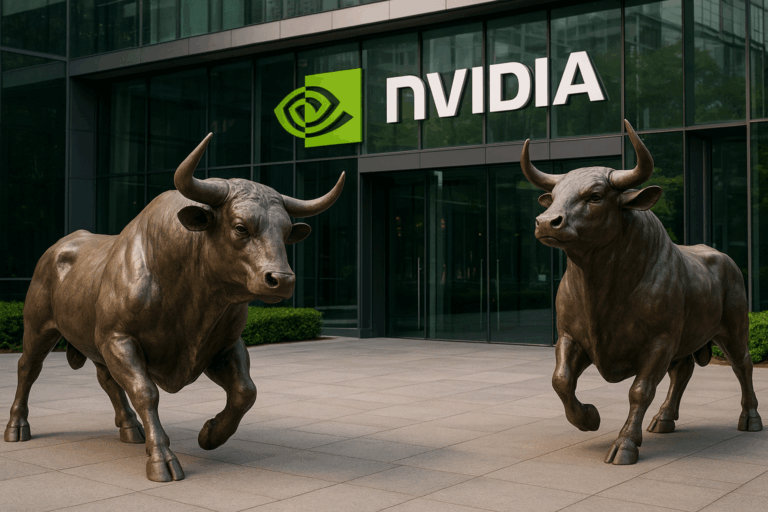
Nvidia stock was staging a modest comeback early Wednesday, as the chipmaker sought to recover from Tuesday’s 4% decline amid mounting concerns over artificial intelligence valuations and renewed uncertainty about US chip sales to China.

AI-related stocks broadly weakened on Wednesday as sentiment remained cautious following a strong run-up across the sector this year.

Advanced Micro Devices (AMD) dropped 5% in early trading on Wednesday, despite management emphasising that “demand for compute has never been greater” during its post-earnings call.

Investors appear increasingly uneasy about whether companies tied to the AI boom can sustain their lofty valuations.

Nvidia, which remains one of the primary beneficiaries of AI infrastructure spending, continues to trade near record highs despite volatility in recent weeks.

China sales prospects dim

The Trump administration confirmed Tuesday that it has no plans to pursue resumed sales of Nvidia’s advanced AI chips to China, narrowing one of the few remaining potential catalysts for near-term upside.

White House press secretary Karoline Leavitt said that President Donald Trump and Chinese President Xi Jinping did not discuss Nvidia’s chip exports during their meeting in South Korea last week.

“As for the most advanced [Nvidia] Blackwell chip, that’s not something we’re interested in selling to China at this time,” Leavitt said.

The statement effectively closes the door on hopes that export restrictions might be relaxed, reinforcing the geopolitical headwinds Nvidia faces as Washington continues to limit China’s access to cutting-edge AI hardware.

Michael Burry’s betting against AI

In a separate development, investor Michael Burry, best known for predicting the 2008 financial crisis, resurfaced on X (formerly Twitter) to warn of what he called a speculative bubble in the AI sector.

Burry, who runs Scion Asset Management, returned to social media after a two-year hiatus with a cryptic post that read: “Sometimes, we see bubbles. Sometimes, there is something to do about it. Sometimes, the only winning move is not to play.”

The final sentence, referencing the 1983 film WarGames, underscored Burry’s belief that the current AI-driven market exuberance could end in widespread losses.

His words were backed by actions. According to regulatory filings, Scion purchased bearish put options on 1 million Nvidia shares and 5 million Palantir shares, valued at roughly $187 million and $912 million, respectively.

Those trades now dominate Scion’s US stock portfolio, which includes just eight holdings in total and only four direct equity positions worth a combined $68 million.

Analysts remain bullish despite volatility

Despite near-term turbulence and high-profile scepticism, analysts remain largely optimistic about Nvidia’s long-term trajectory.

Loop Capital maintained its Buy rating earlier this week, raising its price target to $350 from $250.

Analyst Ananda Baruah forecast that Nvidia could double its GPU shipments to 2.1 million units by early 2026 while continuing to benefit from rising average selling prices.

Goldman Sachs also reiterated its Buy rating last week, lifting its price target to $240 ahead of Nvidia’s upcoming third-quarter results.

The firm expects the company to post a “beat-and-raise quarter,” citing robust data center demand fueled by AI investment.

Goldman analyst James Schneider said investors would be focused on Nvidia’s “$500 billion Datacenter revenue forecast, OpenAI deployments in CY26, and the Rubin ramp in CY26.”

The bank also raised its data center revenue estimate by 13%, citing stronger hyperscaler capital spending and positive management commentary.

Goldman’s third- and fourth-quarter earnings estimates of $1.28 and $1.49 per share remain 3% and 5% above the Street consensus, reflecting continued confidence in Nvidia’s ability to deliver growth despite geopolitical and valuation pressures.

The post Nvidia stock staging a mini comeback after Tuesday’s fall: buy, sell or hold? appeared first on Invezz