

Archive

November 11, 2025

Browsing

The post Ripple News: Evernorth Plans to Expand Beyond $1 Billion as XRP Demand Surges appeared first on Coinpedia Fintech News

XRP has been making headlines after Ripple’s long legal battle with the SEC finally ended. New financial products, like XRP futures on the Chicago Mercantile Exchange (CME) and multiple ETF applications, show that big investors are starting to pay closer attention. Seizing the moment, Evernorth — a digital asset company led by Asheesh Birla, has launched a $1 billion treasury business focused on XRP.

This move comes as the crypto world begins to grow up. After years of trial and error, the industry is moving toward a more stable and professional phase. The focus now is on creating tools and services that make it easier for traditional financial institutions to take part in blockchain-based systems..

Going Global

In an interview with Thinking Crypto, the CEO recently said that Evernorth’s $1 billion goal isn’t the finish line,  it’s just the beginning. The company plans to raise more funds in the future and expand into global markets where XRP already has a strong following, especially in Japan and South Korea.

With backing from Ripple, SBI Holdings, Arrington XRP Capital, and other major investors, Evernorth aims to use these partnerships to strengthen XRP’s presence in Asia and beyond. Its collaboration with SBI, in particular, could help open new doors for XRP’s use in the region’s financial networks.

According to Birla, crypto’s long-term success depends on widespread institutional participation. Evernorth aims to make it easier for large investors and companies to access and hold XRP, forming part of what he calls the “adult movement” in digital assets.

“This ecosystem won’t flourish until there is broad-based adoption by institutions,” he explained. “Evernorth is one tool to help get there, making it easier to participate in the crypto economy and in the financial future being built on blockchains.”
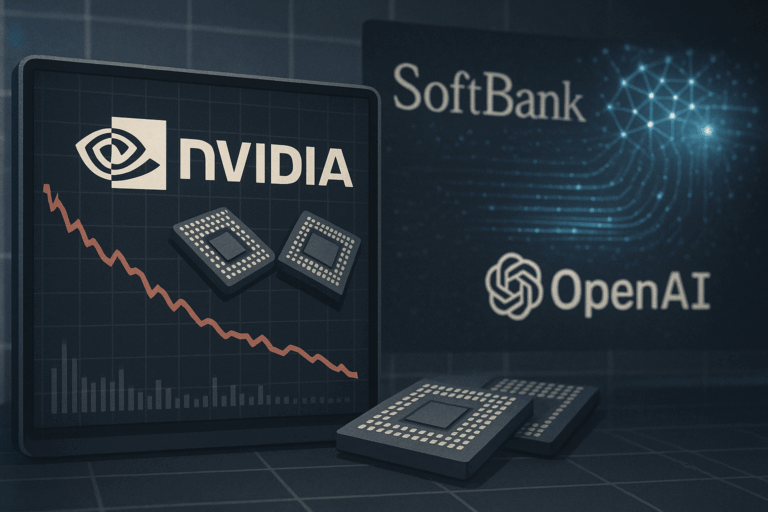
Nvidia shares slipped early Tuesday after Japan’s SoftBank Group disclosed it had sold its entire stake in the chipmaker for $5.83 billion in October.

The stock fell 2.3% to $194.43 on Tuesday morning, following a 5.8% gain the previous day amid optimism surrounding the end of the US government shutdown.

SoftBank revealed the sale as part of its fiscal second-quarter earnings report, which showed a surge in net profit, largely driven by gains from its investment in ChatGPT developer OpenAI.

Although the Nvidia stake sale is small relative to the company’s $4.8 trillion market capitalization, the move comes ahead of Nvidia’s earnings report on November 19 and amid growing debate about stretched valuations across the artificial intelligence sector.

SoftBank’s sale also marks the end of a long investment chapter.

The Japanese conglomerate was once among Nvidia’s largest shareholders and had even offered to help CEO Jensen Huang take the company private.

However, founder Masayoshi Son gradually reduced the position, missing out on potential gains worth hundreds of billions of dollars as Nvidia’s stock skyrocketed during the AI boom.

Analysts stay bullish as focus turns to earnings

Despite SoftBank’s exit, Wall Street remains optimistic about Nvidia’s near-term prospects.

UBS analyst Timothy Arcuri maintained a Buy rating on the stock with a $235 price target, expressing confidence ahead of the company’s upcoming results.

Arcuri projects Nvidia will report earnings per share of $1.29 on revenue of $56.2 billion, slightly ahead of consensus estimates.

“A big focus of the [earnings] call will clearly be how quickly all of this AI infrastructure can be installed and any customer concentration risks that may develop,” Arcuri wrote in a note to clients.

His comments reflect investor attention on Nvidia’s ability to manage supply and deployment challenges as demand for AI chips continues to surge.

Those challenges were evident in recent results from CoreWeave, an AI infrastructure company that buys Nvidia chips and counts the chipmaker among its investors.

While CoreWeave posted better-than-expected revenue earlier this week, its shares fell after the company disclosed delays at a data center project managed by a partner.

SoftBank doubles down on OpenAI and AI infrastructure

SoftBank’s decision to divest from Nvidia appears driven by a strategic pivot toward a deeper commitment to OpenAI and the broader AI infrastructure ecosystem.

Chief Financial Officer Yoshimitsu Goto said during the company’s earnings call that the sale “has nothing to do with Nvidia itself,” emphasizing instead SoftBank’s financing needs for its large-scale investment in OpenAI.

SoftBank is leading an investment of up to $40 billion in OpenAI, with $10 billion syndicated to co-investors.

The firm said the entire syndication amount has been committed and that it plans to invest an additional $22.5 billion in OpenAI through its Vision Fund 2 in December.

SoftBank is also partnering with OpenAI on the $500 billion “Stargate” AI infrastructure project.

Masayoshi Son’s long-standing relationship with OpenAI CEO Sam Altman has paid off handsomely so far.

SoftBank’s quarterly net profit more than doubled, fueled by the revaluation of its OpenAI stake, while its shares have also doubled this year.

While Nvidia remains the dominant force in AI chips today, SoftBank’s growing influence in the AI ecosystem, through investments in Arm, Intel, and potential chip design ventures, hints at its broader ambitions.

For investors, the shift underscores how the AI arms race is evolving, as longtime partners may soon become rivals in the next phase of the semiconductor and AI infrastructure battle.

The post Nvidia stock slip after SoftBank sells $5.83B stake to fund OpenAI bet appeared first on Invezz