

Archive

February 12, 2026

Browsing

The post Ethereum Founder Vitalik Buterin Says Paying Users Alone Won’t Save Crypto Apps appeared first on Coinpedia Fintech News

Vitalik Buterin, co-founder of Ethereum, has weighed in on a growing debate within the crypto industry over whether projects must financially reward users to achieve adoption, arguing that incentives can help — but only when used carefully.

His comments came in response to an online discussion claiming that crypto applications cannot attract meaningful usage without airdrops, token rewards or other financial incentives. While Buterin acknowledged that the argument reflects the current realities of the industry, he said the issue is more nuanced than simply “reward users or fail.”

Incentives Can Work — If Used Correctly

Buterin explained that some forms of incentives are economically healthy, particularly when they compensate early adopters for risks associated with using new or experimental platforms. For example, liquidity rewards in decentralized finance (DeFi) can offset the higher technical and security risks that typically exist in early-stage protocols.

In such cases, he said, incentives function as part of a sustainable economic loop rather than a marketing expense.

However, he warned that paying users purely to generate activity, such as incentivizing promotional posts or rewarding users who would not otherwise engage with a mature product, can attract low-quality participation and disappear once payments stop.

Quantity vs. Quality of Users

Buterin warned that aggressive reward campaigns can sometimes create the illusion of adoption while failing to build a committed long-term community. Even if user numbers rise during incentive programs, the overall value of the ecosystem may weaken if participation is driven solely by short-term profit opportunities.

He said that the challenge is particularly important for social or community-driven platforms, where the quality of contributors matters more than the raw number of accounts interacting with the application.

Focus Returning to Real Product Value

According to Buterin, the crypto sector is gradually moving toward a model where long-term success depends less on incentive-driven growth and more on building applications that people genuinely want to use. The most effective incentives, he argued, are those that temporarily compensate for the early disadvantages of a young platform and naturally fade as the product matures.

“The bulk of the effort should be on making an actually useful app,” he wrote, suggesting that the next phase of crypto adoption will favor projects that combine practical utility with carefully designed, targeted incentives rather than relying on broad reward campaigns to attract users.

The operator of roughly 180 Eddie Bauer stores across the U.S. and Canada has filed for Chapter 11 bankruptcy protection, blaming declining sales and a litany of other industry headwinds.

The bankruptcy filing marks the third time in a little over two decades for the storied-but-now-tired brand that began as a Seattle fishing shop, later outfitted the first American to climb Mount Everest and made thousands of newfangled down jackets and sleeping bags for the military during World War II.

Eddie Bauer LLC said Monday it had entered into a restructuring pact with its secured lenders as it made the filing in the U.S. Bankruptcy Court for the District of New Jersey.

Most Eddie Bauer retail and outlet stores in the U.S. and Canada will remain open as the company winds down certain locations. It noted that it will conduct a court-supervised sales process, and if a sale can’t be executed, it will begin a wind-down of its U.S. and Canadian operations.

“This is not an easy decision,” said Marc Rosen, CEO of Catalyst Brands, which maintains the license to operate Eddie Bauer stores in the U.S. and Canada. “However, this restructuring is the best way to optimize value for the retail company’s stakeholders and also ensure Catalyst Brands remains profitable and with strong liquidity and cash flow.”

Eddie Bauer’s stores outside of the U.S. and Canada are operated by other licensees, are not included in the Chapter 11 filings, and will stay open, according to the release.

Authentic Brands Group continues to own the intellectual property associated with the Eddie Bauer brand and may license the brand to other operators, the company said. The operations of other brands in the Catalyst Brands portfolio are not affected by this filing and will continue in the normal course, according to the company.

Eddie Bauer’s e-commerce and wholesale operations will also not be impacted by the wind down, as they are operated by a company called Outdoor 5, LLC. That was a transition it made in January and became effective Feb. 2.

Eddie Bauer joins a growing list of U.S. retailers this year that are closing stores, as companies reorganize under bankruptcy protection or pare down their operations to focus on the most profitable businesses.

The parent company of Saks Fifth Avenue said last month that it was seeking bankruptcy protection, buffeted by rising competition and the massive debt it took on to buy its rival in the luxury sector, Neiman Marcus, just over a year ago. A few days later, the parent company said it was closing most of its Saks Off 5th stores.

Amazon said earlier this month that it was closing almost all of its Amazon Go and Amazon Fresh locations within days as it narrows its focus on food delivery and its grocery chain, Whole Foods Market.

Eddie Bauer’s namesake founder — an avid outdoorsman — started the company in Seattle in 1920 as Bauer’s Sports Shop, according to the brand’s website. In 1945, after making more than 50,000 jackets for the military, it launched a mail-order catalog.

“Bauer’s Sports Shop was not just a place where people purchased clothing and gear, it was a community hub where folks gathered to share their wisdom, learn, and talk about their experiences in the outdoors,” the website says.

The company created an American goose-down insulated jacket, known as the “Skyliner,” in 1936, and it became the company’s first patented jacket. It also outfitted the first American to climb Mount Everest — James W. Whittaker — with an Eddie Bauer parka in 1963.

After Bauer retired in 1968 and sold the business to his partner, the outdoor brand shifted more toward casual apparel and was bought by General Mills Inc. in 1971 and then by Spiegel Inc. in 1988. After Spiegel filed for bankruptcy in 2003 and most of its assets were sold, the remainder of the company was reorganized in 2005 as Eddie Bauer Holdings Inc.

In June 2009, Eddie Bauer filed bankruptcy and was acquired by Golden State Capital, the following month. In 2021, it was acquired by Authentic Brands and SPARC Group LLC.

A year ago, Catalyst was formed by the merger of SPARC and JCPenney, which Simon Property Group and fellow mall landlord Brookfield bought out of bankruptcy.

Rosen noted that even prior to the inception of Catalyst Brands last year, Eddie Bauer was in a “challenged situation.”

“Over the past year, these challenges have been exacerbated by various headwinds, including increased costs of doing business due to inflation, ongoing tariff uncertainty, and other factors,” he said.

He noted that while Catalyst’s leadership was able to make improvements in product development and marketing, those changes could not be implemented fast enough to fully address the problems created over several years.

Eddie Bauer had nearly 600 stores at its peak in 2001, according to CoStar Group Inc., a commercial real estate data firm.

In a note published earlier this month, Neil Saunders, managing director of GlobalData Retail, wrote that while the Eddie Bauer name is “well known,” the brand hasn’t kept pace with rivals like Swedish outdoor brand Fjallraven and Canadian label Arc’teryx. He also cited issues with quality deteriorating, which, for an outdoor brand measured by the performance of its products, is very problematic.

“And for many younger shoppers, the brand is seen as somewhat old-fashioned and a bit irrelevant,” he said.

This post appeared first on NBC NEWS

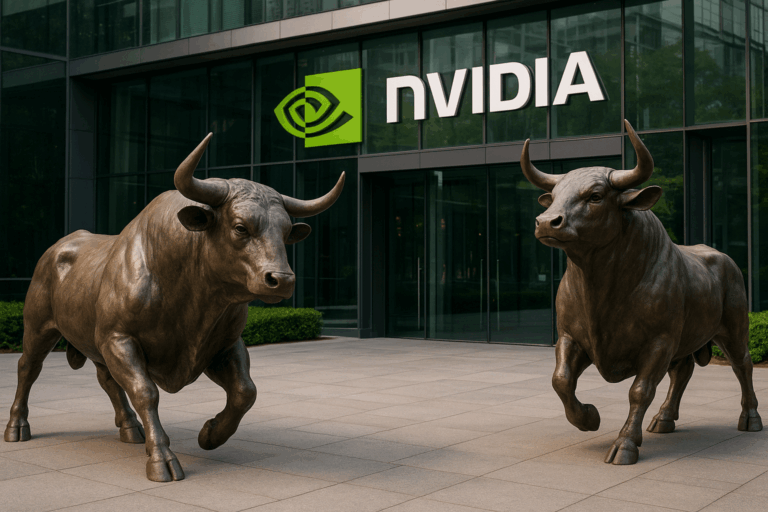
Nvidia stock moved higher in early trading on Thursday, with the chipmaker once again testing the upper end of its recent range as investors positioned ahead of its earnings report later this month.

Nvidia shares were up 0.8% at $191.11. The Nvidia stock has climbed 11% over the past five trading sessions but has largely traded sideways since November.

The surge today comes even as other AI stocks such as Meta, Microsoft and Amazon were struggling at the bourses.

Chinese AI stocks rally on model upgrades

At the same time, artificial intelligence-related shares in China posted strong gains on Thursday after several companies unveiled upgraded models.

Hong Kong-listed Zhipu AI, which trades as Knowledge Atlas Technology, surged nearly 30% to close at 405 Hong Kong dollars after releasing GLM-5, an open-source large-language model featuring enhanced coding capabilities and longer-running agent tasks.

Shares of MiniMax jumped 14% to 70.5 Hong Kong dollars following the launch of its updated M2.5 open-source model, which includes expanded AI agent tools.

The company described its M2 model as built for coding and agentic workflows.

Shanghai-listed UCloud Tech, which provides computing support for Zhipu, rose 20% to hit its daily trading limit.

Meanwhile, SenseTime, which has shifted its focus toward AI software platforms, gained 6.8% in Hong Kong trading.

According to the South China Morning Post, DeepSeek upgraded its flagship AI model on Wednesday to support a larger context window and more up-to-date knowledge.

US lawmaker signals flexibility on China chip sales

In Washington, debate over chip exports resurfaced as Ro Khanna, the ranking member on the House Select Committee on China, indicated he may support allowing sales of older-generation Nvidia chips to China.

Speaking to reporters after his first committee hearing, Khanna suggested that once the US establishes a technological lead, certain older chips could be sold abroad while restricting access to the latest products.

“We certainly shouldn’t be sending them Rubins. We shouldn’t be sending them Blackwells,” Khanna said.

“But after we have a two-year, three-year advantage, then I’m fine to make sure that our chips are being used in refrigerators and dishwashers and that that is something that we’re selling.”

Earnings and guidance in focus

Investors are now looking to the company’s January-quarter results, scheduled for release on February 25, for a potential catalyst.

According to a FactSet survey of analysts, Nvidia is expected to report adjusted earnings of $1.49 per share on revenue of $65.58 billion.

While the headline numbers are closely watched, forward guidance is likely to be the key driver of the stock’s next move.

Timothy Arcuri of UBS wrote this week that investor expectations for Nvidia’s April quarter may already be running ahead of consensus estimates.

He suggested that the market likely expects revenue in the $74 billion to $75 billion range, compared with the current FactSet consensus forecast of $71.59 billion.

The gap underscores the high bar facing Nvidia after years of rapid growth tied to artificial intelligence infrastructure spending.

The post Why Nvidia stock is up around 1% while other AI giants struggle appeared first on Invezz