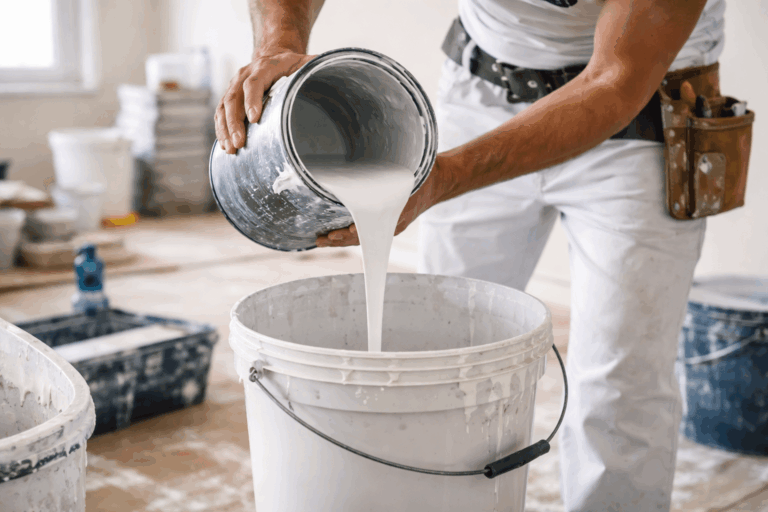
Indian paint companies are facing renewed pressure as rising crude oil prices, softer demand trends, and intensifying competition weigh on the sector’s outlook.
Shares of major paint manufacturers have declined sharply in recent trading sessions, reflecting concerns that higher input costs and slowing consumption could squeeze profitability.
The sector’s vulnerability stems largely from its heavy reliance on crude-linked raw materials.
With geopolitical tensions pushing oil prices higher, analysts say paint companies may struggle to maintain margins while balancing price increases and demand risks.
Rising crude prices squeeze margins
Crude oil derivatives account for roughly half of paint manufacturers’ raw material costs, including solvents, resins and emulsions.
As global oil prices rise, these input costs increase, putting immediate pressure on profit margins.
The recent surge in crude prices followed escalating tensions in the Middle East after joint US and Israeli strikes on Iran triggered retaliation and concerns about disruptions to global energy supply.
Brent crude futures rose sharply by 25% in the week, climbing above $90 per barrel in the week. West Texas Intermediate crude also surged, jumping more than 32% to around $88 per barrel.
The escalation raised concerns about the Strait of Hormuz, one of the world’s most important oil transit routes.
Nearly 20% of global oil flows and more than 40% of India’s crude imports pass through the narrow waterway.
According to consultancy Wood Mackenzie, a prolonged disruption could push oil prices above $100 per barrel if tanker flows are not quickly restored.
For India, which imports about 85% of its crude oil requirements, higher energy prices create a significant ripple effect across industries that rely heavily on petrochemical inputs, including the paint sector.
Higher input costs can compress gross margins and force companies to consider price increases, which in turn may affect demand.
Paint stocks fall amid industry concerns
Investor concerns about these pressures have already been reflected in the stock market.
Shares of several major paint companies dropped sharply as crude prices surged.
Berger Paints fell about 7% in the last month, while Asian Paints and Akzo Nobel India slipped 5%, Kansai Nerolac Paints plunged 11%, and Shalimar Paints nosdived more than 14%.
Brokerage firm HSBC said rising input costs could force paint makers to increase prices selectively, though the ability to pass on costs may be limited.
HSBC maintained a “hold” rating on Asian Paints but lowered its target price to ₹2,600 from ₹2,900.
It also kept a “hold” rating on Berger Paints while reducing the target price to ₹500 from ₹540, citing moderated margin expectations.
The brokerage noted that the market structure has evolved since earlier inflation cycles, making it more difficult for companies to protect margins.
Even as companies attempt price hikes to offset higher costs, competition in the sector remains intense.
Analysts say these structural changes could limit the effectiveness of pricing actions compared with past periods of inflation.
Demand trends add further pressure
Beyond cost pressures, the sector is also grappling with changes in consumer behaviour.
Industry growth has slowed as discretionary spending patterns shift, with more consumers allocating budgets to travel and hospitality rather than home improvement projects.
People are also seemingly painting less of their homes according to paint company executives.
“Growth has periods of cyclicity. While the CAGR remains strong, we are seeing some changes in consumption trends. The frequency of painting has slowed down. Occasion-led painting has reduced; for example, more people are opting for destination weddings rather than home-based weddings, which leads to a postponement of painting. Since painting is a discretionary spend, people are currently investing more in travel and hospitality,” Amit Singhal, MD & CEO Asian Paints said in a recent earnings call.
Demand patterns have also diverged between rural and urban markets. Rural areas performed relatively better in recent months due to favourable rainfall and improved sentiment.
Brokerage CLSA warned that companies across consumer sectors could face margin pressure if crude-linked costs continue to rise and firms cannot fully pass these increases on to consumers.
Higher inflation could also weaken discretionary spending, slowing demand for products such as paints and other home improvement goods.
In this environment, paint companies may face a difficult balancing act: managing rising raw material costs while navigating subdued demand and competitive pressures in a rapidly evolving market.
The post Indian paint stocks slump as crude surge, weak demand hit margins appeared first on Invezz