The Litecoin price is slowly gaining attention, not due to its strength, but rather because it is entering one of the critical support zones. The price has plunged by 2.19%, trading at $53.78 in the past 24 hours. There has been a marginal rise in the volume, which seems to have intensified the upward pressure. As LTC approaches the $50–$60 zone, the chart is showing repeated reactions from this area across multiple cycles.
The question now is simple: is this a base forming for the next move up, or is this support finally giving way?
On the higher timeframe, Litecoin has tested this zone multiple times and bounced each time. That kind of repeated reaction usually means one thing—buyers are active here. Price is now back in the same region, but with a different structure. The recent move down has been sharp, and momentum isn’t strong yet. Still, the fact that LTC is holding above this zone keeps the bullish case alive.
As seen in the above chart, the range between $50 and $60 is the key demand area, wherein the price has reacted multiple times. Hence, if the structure loses this range, the rally could lose its strength. However, the price still sits above the range, indicating it has entered a decisive point. The repeated bounces from a multi-touch support base, which often leads to strong moves if held.
The Litecoin (LTC) price is not trending right now, but it’s sitting at a level that decides what comes next. If the $50–$60 zone holds, a bounce toward $100 first becomes likely. From there, continuation toward $150 and $200+ opens up if momentum builds. But if this level breaks cleanly, the entire bullish setup fails, and LTC could enter a deeper correction phase. For now, this is a reaction zone, not a breakout zone.
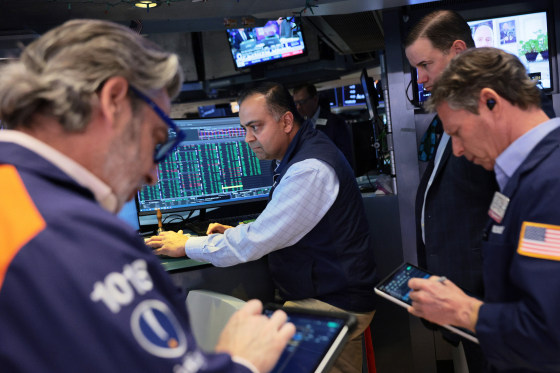
U.S. stocks rose Wednesday and global oil prices fell in yet another volatile trading session as traders and investors were buffeted by constant headlines about the war in Iran.
News of a 15-point U.S. peace plan proposal sparked hopes early in the day that the Trump administration was moving to end its monthlong war against Iran. Initially, the S&P 500 and the Nasdaq 100 futures rose more than 1%.
But reports that Iran had responded negatively to the proposal briefly knocked index futures off their pre-market highs and lifted oil prices off their morning lows.
Despite the early setback, stocks closed the trading day higher. At 4 p.m. ET, the S&P 500 index was up about 0.4%, the Nasdaq Composite closed 0.7% higher, and the Dow jumped 305 points. The Russell 2000 index of smaller companies rose 1.1%.
The price of U.S. crude oil also traded off its lowest levels of the day and was down only 1.4% to about $90 per barrel by late afternoon. West Texas Intermediate crude oil has soared more than 30% since the start of the war on Feb. 28. The cost per barrel is up 50% since the beginning of the year.
International Brent crude prices traded near breakeven, at around $102 per barrel. The price of heating oil, a proxy for jet fuel, dropped 6%.
The global price of oil directly affects what Americans pay at the gas pump and what it costs them to heat and cool their homes. The average nationwide price of unleaded gas Wednesday was $3.98 per gallon, according to AAA data.
“Markets desperately want to believe in the positive,” UBS Global Wealth Management chief economist Paul Donovan wrote. “Focus on the apparent 15-point US plan to end the war has received more attention than Iranian dismissals of this, or the fact that passage through the Strait of Hormuz is minimal.”
Iran’s response to the U.S. proposal included a list of five conditions for ending the war, according to Iranian state TV, which cited a senior political-security official with knowledge of the details of the proposal.
Pakistan has also offered to mediate talks to end the hostilities, four sources told NBC News. A Persian Gulf official said Pakistan had been passing messages between the two countries for the past two days.
An in-person meeting between the U.S. and Iran could be held in the coming days, two sources added.
But President Donald Trump has continued to give conflicting signals.
On March 16, Trump said he was delaying his scheduled visit to China “by a month or so” to monitor the war. On Monday, he said the Strait of Hormuz would be “open very soon.”
And on Tuesday, Trump told reporters in the Oval Office, “This war has been won.” At the same time, the U.S. is sending more than 1,000 additional troops to the Middle East, sources said.
A motorist drives past a sign displaying prices at a gas station in Oakland, Calif., on Tuesday.Godofredo A. Vásquez / AP
Since the war started, the market has experienced several days like this, when markets are whipsawed by constant back-and-forth comments.
“There’s really no way to know at this point what the facts are regarding the state of negotiations, as neither side has any real incentive to conduct talks via the press, so expect more whipsaw action as things continue to progress,” analysts at Bespoke Investment Group wrote in a client note.
They added that the “ongoing tensions continue to support higher prices [and] stoke inflation concerns” and are likely to cause central banks to remain on hold, rather than cut rates.
On the contrary, traders believe the European Central Bank and the Bank of England will both raise interest rates.
“Uncertainty remains high,” analysts at ING wrote in a note Wednesday morning. “Overall, volatility remains elevated and a geopolitical risk premium persists.”
In the 18 trading sessions since the war began, U.S. oil prices have closed down only five times. Likewise, over the same period, the S&P 500 has closed higher only seven times. Three of those higher closes were only fractional.
After Wednesday’s close, the Nasdaq was down nearly 6% for the year, while the S&P 500 was on track for a 3.5% loss so far. The majority of those losses were concentrated in the weeks since the war began.
Meanwhile, the Strait of Hormuz, through which 20% of the world’s oil supply typically passes, has remained at a near standstill since the war began.
On Monday, just five ships passed through the strait, according to data compiled by S&P Global Market Intelligence. On Tuesday, the total was six. On many days since the war started, not a single ship has passed through.
However, some of the ships passing through the strait have taken an unusual course that put them close to the Iranian coastline, potentially signaling that Tehran was keeping a tight grip on traffic flows. Two Indian ships were granted passage Tuesday after a deal with Iran, Bloomberg News reported. The Iranian navy also guided the ships.
Otherwise, hundreds of other ships loaded up with cargo, oil and liquefied natural gas remain stuck.
Nvidia shares remain under pressure, tracking a broader pullback in artificial intelligence-linked stocks.
The stock fell 1.8% in early trading on Friday, after dropping 4.2% on Thursday to its lowest close since mid-December. It is now down around 10% for the year.
The weakness reflects a shift in investor sentiment. AI-driven technology stocks, once market leaders, are losing favour.
Nvidia’s valuation has also eased. The stock now trades at a forward price-to-earnings multiple of 19.7 times, according to FactSet.
This is below the 20.3 times average for the S&P 500, despite Nvidia’s stronger growth outlook.
This marks a break from the past. Nvidia had traded at a premium to the index for over a decade.
That trend has shifted since the Iran conflict began on February 28, according to Dow Jones Market Data.
Analysts point to strong product pipeline
Despite recent declines, analysts remain positive. Wolfe Research reiterated its Outperform rating and set a $275 price target.
The optimism follows Nvidia’s GTC announcements, including Rubin Ultra “Pods” for AI data centres.
The company described these as a reference design for agentic AI systems.
Nvidia said new products—such as CPUs, storage, and Groq-related components—could add revenue equal to 50% of current VR compute rack sales.
The Groq 3 LPX rack could add another layer of growth. Nvidia estimates it offers a 25% incremental opportunity over VR200 racks.
These systems are designed for low-latency inference, enabling premium pricing.
Data centre outlook seen as conservative
At its GTC event, Nvidia projected $1 trillion in data centre revenue from its Blackwell and Rubin GPUs.
Wells Fargo analyst Aaron Rakers said this estimate may be conservative.
“We see 15%-20%+ upside to NVDA’s 2026-2027 data centre estimates,” he wrote.
Rakers, who has an Overweight rating and a $265 price target, pointed to rising demand from large cloud providers.
These firms are expected to deploy about 22 gigawatts and 25 gigawatts of AI capacity in 2026 and 2027.
Cramer remains bullish on Nvidia stock
Geopolitical tensions are also influencing markets. CNBC’s Jim Cramer said investors are thinking more like strategists than stock pickers.
“We know we can’t predict the outcome of the war. We can’t predict the timing either as tonight’s bombing pause extension shows … But what we can gauge is whether the stocks we like have much of a connection to the war,” Cramer said.
He said Nvidia’s direct exposure to the conflict is unclear.
“Nvidia is a big part of the stock market itself, and so it’s the easiest stock in the world to trade. I think it’s going down because it is so easy to get back in at a lower level.”
Interest rates are another concern. Higher rates could slow data centre investments.
“That said, if the war ends soon and we have a new Fed chief, you’ll feel like a moron for staying away from Nvidia,” Cramer said.
Cramer said the tech industry still lacks enough compute and memory capacity.
“Right now, the tech industry is short on what we call compute and its also short on memory. That means it’s short the computers that have Nvidia inside,” he said.
Higher memory costs could raise server prices and affect budgets. Still, demand for Nvidia’s products remains strong.
Cramer also downplayed energy concerns. “Nvidia’s data centres run mostly on natural gas, which is US-based and has barely budged,” he said.
He added that while risks remain, the current pullback could offer an opportunity.
“You’re ultimately being given a chance to buy a high-quality stock at a lower price than you’d normally expect,” Cramer said.
Despite the bullish calls, Nvidia shares have failed to move higher in the last few months.
However, that has not deterred retail investors. As per recent market data, Nvidia remains one of the most traded stocks.
Retail traders on online trading apps have been one of the most ardent backers of the AI darling.