SUI Network is starting to look like one of those projects whales accumulate quietly while retail traders argue over candles on social media. According to CryptoQuant data, large-volume buyers have been aggressively absorbing SUI in the $0.80 to $1.00 range during recent consolidation phases, creating what traders now view as a major macro support pocket.
Whale Wallets Quietly Load SUI Positions
The latest Spot Average Order Size data points toward heavy institutional-style accumulation inside the $0.90–$1.00 range. Instead of chasing pumps, larger players appear to be using sideways price action to build positions without sending the market vertical too early.
Well, the same range also aligns with compressed short-term moving averages, reinforcing the idea that SUI has established a structurally important demand zone. If price revisits that area again, traders expect buyers to defend it aggressively.
SUI Ecosystem Growth Accelerates Rapidly
Meanwhile, the network itself keeps expanding. Ledger reported SUI as one of its top trending assets this week with a 21.75% jump in trading volume activity inside the wallet ecosystem.
At the same time, tokenized real-world asset activity exploded. Just seven days after launch, users traded more than $200 million in tokenized TradFi assets through Astros AG. Stablecoin liquidity is also deepening, with CurrentSUI reaching $8.89 million in natively backed supply alongside a 72% utilization rate.
So, what’s next? SUI developers are preparing one of the network’s most anticipated upgrades yet.
Gasless Transfers Could Change Everything
Next week, SUI plans to roll out gasless transfers, removing the need for users to hold native tokens just to complete transactions. That may sound technical, but it fundamentally changes onboarding friction for mainstream users.
But reality is that this is exactly the kind of infrastructure shift institutional players usually front-run early. Between whale accumulation, expanding ecosystem activity, and the incoming gasless upgrade, SUI is rapidly positioning itself as one of the more closely watched Layer-1 networks in the market.
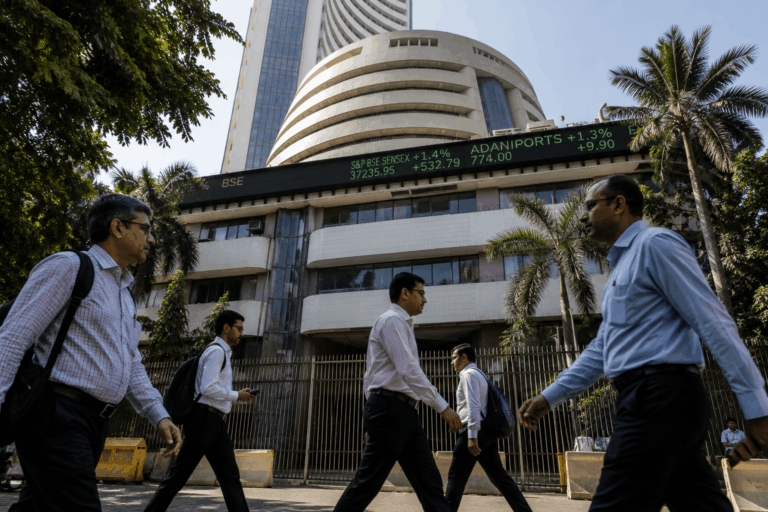
Indian capital market stocks have emerged as one of the strongest-performing pockets of the market over the past year.
The muted benchmark index performance has done nothing to limit the rally.
At the time of writing, while the Nifty 50 has declined by 5.66% over the last year, the Nifty Capital Market index surged nearly 39% in the same period.
Exchange operators, brokerages, and asset managers have led this outperformance.
Businesses that benefit from market participation.
Stocks such as BSE Ltd, Multi Commodity Exchange of India, Groww, Nippon India Life Asset Management, and Angel One have delivered strong returns ranging from 19% to as high as 173%.
The rally has come despite a challenging backdrop marked by volatile markets, slower earnings growth, and a noticeable moderation in retail trading activity.
Company
1-Year Stock Performance
BSE Ltd
63%
Multi Commodity Exchange of India
173%
Groww
42%
Nippon India Life Asset Management
54%
Angel One
19%
As of Friday, May 15.
A “pick-and-shovel” play on market participation
The outperformance of the capital market stocks is a “pick and shovel” play for the investors as the broader markets struggled.
These companies benefit from overall market activity, which insulate them from specific sectors.
This positioning has made them attractive in uncertain environments.
Harini Dedhia, Fund Manager and Director at Tamohara Investment Managers, explains the appeal as a hedge against uncertainty.
“It is almost a hedge against FOMO. If one is not convinced about individual stocks, or which sector/ pockets will do well, it makes sense to participate in capital market stocks- a leveraged way to play any up move in the market,” she told Invezz.
This dynamic has been particularly relevant over the past year, as broader markets struggled to maintain direction.
Investors have bet on intermediaries that earn from trading volumes, asset flows, and participation trends.
Strong earnings momentum in exchanges
Multi Commodity Exchange of India has been one of the standout performers, with its stock rising 173% over the past year.
The company’s financial performance reflects a sharp improvement in trading activity.
In Q4 FY26, MCX reported net profit of Rs 530 crore, more than doubling from Rs 135 crore a year earlier. Revenue also surged to Rs 889 crore from Rs 291 crore.
BSE Ltd has also delivered strong gains, with its stock rising 63% over the past year.
Its Q4FY26 Revenue increased to Rs 1,564 crore from Rs 847 crore, while net profit jumped to Rs 795 crore from Rs 494 crore.
Retail participation slows
Despite strong capital market company performance, retail trading activity has slowed down over the last year.
Active client accounts on the National Stock Exchange declined 7% year-on-year to 4.57 crore in March 2026, down from 4.92 crore a year earlier.
That is a drop of nearly 35 lakh accounts, showing a participation slowdown.
New account additions have failed to offset churn in accounts.
However, this slowdown has not been uniform across players.
Groww has increased its market share to 28.31% from 26.26%, leading industry additions in the March quarter.
The platform contributed more than 100% of net additions in January and maintained strong momentum through February and March.
Cyclical nature of retail trading
Experts broadly agree that the decline in retail activity is cyclical rather than structural.
Dedhia describes retail trading as “a high beta bet on the market,” noting that participation tends to rise and fall with sentiment.
She adds that if “animal spirits” return and sustain for a few months, volumes are likely to pick up again.
Chandraprakash Padiyar, Senior Fund Manager, Tata Asset Management, attributes the recent slowdown to a combination of weaker sentiment, slower corporate earnings growth, and regulatory tightening.
“Volumes are a function of corporate earnings growth, market liquidity driven by sentiment, and valuations. Over the past 12-18 months, corporate earnings growth slowed down post a very strong period of high growth consistently between FY2021 and FY2024.
Since 2025, sentiment has been weaker, along with some regulatory tightening in terms of higher STT and F&O norms. We believe a mix of all of the above factors has led to slower retail volumes,” he added.
However, he believes improving earnings prospects and more supportive monetary conditions could revive participation.
Commodities and diversification boost earnings
One of the key drivers of recent earnings growth has been increased activity in commodities markets, particularly gold and crude oil.
Padiyar said increased trading activity due to high commodity prices of gold and crude has played a role in the fundamentals of certain capital market companies.
Dedhia also noted the same.
“Commodities ADTO for the online brokers has seen 50-70% growth q-o-q. That, along with the adoption of wealth management by digital-first broking platforms, has helped earnings this past quarter,” she added.
AMCs have done better than most other equity-only players because of their multi-asset approach. Precious metal ETFs and their presence in multi-asset, plus SIPs at lower levels in midcaps and small caps, have aided their performance
Regulatory changes: headwind or minor impact?
Recent regulatory changes, including tighter norms in the futures and options (F&O) segment and higher transaction taxes, have had some impact on trading volumes.
However, experts suggest that market conditions play a much larger role.
Dedhia emphasizes that stagnant markets pose a bigger risk to earnings than regulatory tweaks, while Padiyar notes that such changes tend to have a more pronounced effect during weak or range-bound markets.
Since 2025, market sentiment is weak on the back of slower corporate earnings growth, which in our view was temporary and due to cyclical reasons. Select policies to curb excessive speculation, like STT, F&O norms, did have a short-term bearing on volumes in a weak or consolidating market. Ultimately, volumes depend on sentiment and money-making opportunities in the market. Regulatory changes does tend to impact volumes in a weak market.
Key risks to the rally
Despite strong performance, risks remain for capital market stocks.
The most significant risk, according to Dedhia, is a prolonged period of stagnant or range-bound markets.
“A market that doesn’t have any direction- up or down. Constantly choppy and range-bound. That is the single biggest risk. Any significant adverse tinkering on capital gains taxation could be another,” she added.
Padiyar highlights valuations as another concern. He cautions that during periods of optimism, investors may overestimate growth prospects, leading to elevated valuations.
“Capital Market stocks tend to be cyclical in nature and move with the markets. These businesses are people-led and have high fixed costs. Any volatility in revenue can lead to sharp movements in profitability,” he noted.
Can the outperformance continue?
The outlook for capital market stocks over the next 2–3 years remains tied to broader market conditions and earnings growth.
Dedhia maintains a constructive long-term view, pointing to the ongoing financialisation of savings in India as a key structural driver.
“I cannot comment on prices in the near term, I do believe these businesses have a very long runway for growth.”
Padiyar also sees potential for sustained growth, provided corporate earnings recover as expected.
He notes that improving macro conditions, including supportive monetary policy and better nominal GDP growth, could help revive sentiment and trading volumes.
However, he added that “barring a few, most capital market-related businesses do have a good earnings growth assumption being built into the stock prices over the next 2-3 year horizon. We need to monitor actuals against expectations for stock performance to sustain.”
Binance Coin (BNB) is quietly re-entering the spotlight as a combination of whale accumulation, accelerating ecosystem growth, and improving technical signals reignites bullish momentum. While much of the market remains focused on Bitcoin’s struggle near key resistance and Ethereum’s institutional flows, BNB has been steadily building strength beneath the surface.
Meanwhile, the charts are beginning to reflect renewed optimism, with BNB price approaching a key breakout zone near $690 that could determine its next major move. If momentum continues to build, traders are increasingly asking whether Binance Coin could be setting up for a 40% rally from current levels.
BNB Chain Fundamentals Strengthen as Liquidity Surges
One of the strongest bullish narratives supporting BNB comes from the rapid growth unfolding inside the BNB Chain ecosystem. According to ecosystem data, BNB Chain’s stablecoin supply has climbed above $16 billion, more than doubling from roughly $7.3 billion recorded a year ago. The expansion points to rising liquidity across the network and stronger activity spanning decentralized finance (DeFi), payments, and on-chain trading.
BNB CHAIN STABLECOIN SUPPLY DOUBLES
According to data on the @artemis platform, @BNBChain's stablecoin supply has surged to reach more than $16 billion.
In April 2025, this figure stood at just $7.3 billion, meaning $BNB's stablecoin ecosystem has more than doubled in the space… pic.twitter.com/97qRML5oZg
Historically, expanding stablecoin supply has acted as a leading signal of growing capital participation, often strengthening demand for native ecosystem assets. The improving fundamentals are also beginning to reflect in market positioning. BNB recently surpassed XRP to reclaim the fourth-largest cryptocurrency ranking by market capitalization, widening its lead as investor sentiment around Binance Coin improves.
Over the past month, BNB has steadily outperformed several large-cap peers, reinforcing the view that capital may be quietly rotating back into the Binance ecosystem. At a time when traders remain focused on Bitcoin and Ethereum narratives, BNB’s ecosystem growth and rising market dominance suggest the asset may be regaining strength faster than many expected.
Whale Accumulation Sparks Speculation of Bigger Move
Adding fuel to bullish sentiment, on-chain tracking accounts recently flagged a substantial whale transaction tied to investor Garrett Jin, a long-term crypto market participant. Whale data suggests the investor acquired 71,066 BNB valued at approximately $48.2 million, reportedly sourced through Binance.
Garrett Jin (the #Bitcoin OG 10/11) bought 71,066 $BNB worth $48.22M from #Binance.
The transaction stands out not only because of its size, but also due to its timing. Reports indicate the same entity previously moved over $1.35 billion worth of Ethereum onto Binance, fueling speculation that portfolio capital may be rotating toward BNB exposure.
Large whale purchases during consolidation phases are often interpreted as signs of confidence, particularly when broader market sentiment remains uncertain. Separately, BNB has also regained momentum relative to XRP, reclaiming a stronger position among top cryptocurrencies by market capitalization, another signal traders are increasingly monitoring.
BNB Price Prediction: Can Binance Coin Rally 40%?
BNB appears to be approaching a decisive moment. After months of sideways consolidation following February’s correction, Binance Coin is now testing an important breakout zone near the $720 resistance level, a region that has repeatedly capped upside attempts. However, the structure beneath the surface appears to be improving.
BNB price action has stabilized inside a broad accumulation range, while momentum indicators suggest bearish pressure may be fading. More importantly, BNB is beginning to flash signs of a bullish moving-average crossover, a technical signal frequently associated with early trend reversals.
BNB daily price chart also shows buyers gradually reclaiming control, with price continuing to print higher lows while volume stabilizes, often viewed as a sign of stealth accumulation. If bulls secure a confirmed breakout above $720, the next major resistance sits near $960, representing roughly 40% upside from current price levels.
A sustained move above that region could potentially bring the psychological $1,000 milestone back into focus. However, rejection at resistance would likely keep BNB trapped within its broader range, with downside support emerging between $640 and $650, an area buyers have consistently defended in recent months.
Final Words
BNB’s price setup is notable because fundamental growth and technical momentum appear to be aligning at the same time. Rising stablecoin liquidity, whale accumulation, and strengthening price structure suggest Binance Coin may be transitioning out of consolidation and into an early-stage expansion phase. For now, the market’s attention remains fixed on one key level: $720. If bulls flip that resistance into support, a 40% rally toward $960 may no longer seem overly ambitious, it could become the market’s next major target.
Shares of Intel (INTC) and Advanced Micro Devices (AMD) are bleeding red this morning amidst a broader macro-driven sell-off across the US semiconductor names.
Investors seem to be taking profit following parabolic multi-week rallies that have seen valuations soar to historic extremes.
In fact, UBS analysts labeled current multiples as “statistical outliers” – flashing bubble-like signals in a research note today.
Plus, this mass exit is being exacerbated by defensive positioning ahead of Nvidia’s “high-stakes” quarterly results scheduled to be revealed on May 20.
With a 95% probability of a “beat and raise” already priced into the market, investors are choosing to de-risk across the entire AI complex rather than gamble on further upside.
Why AMD stock is slipping today
While AMD remains a favourite of the AI revolution, it’s currently buckling under a surge of macro volatility.
The 10-year Treasury yield climbed to a new high on Friday, draining liquidity from high-growth tech stocks whose future earnings are now being discounted at a higher rate.
Compounding this “risk-off” sentiment are escalating Middle East tensions involving Iran – which have spiked Brent crude prices and revived fears of “sticky” inflation.
Consequently, the futures market is now pricing in higher odds of a Fed “rate hike” rather than the long-awaited cut, a scenario that is toxic for capital-intensive industries like chip manufacturing.
Adding fuel to the fire on May 15 is a new report from UBS, warning that the AI server gold rush is entering a hyper-competitive phase.
As Arm-based chips and custom silicon gain traction, analysts fear the margins for traditional x86 CPU players could be squeezed, forcing a re-evaluation of AMD shares’ premium multiple.
Why Intel shares are crumbling today
Beyond the aforementioned macroeconomic headwinds, Intel stock is also seeing pressure because of a more localized catastrophe.
UBS data reveals a staggering blow to its core business: Intel’s server CPU market share has tanked to 54.9%, marking a brutal sequential decline of 370 basis points.
Reports now indicate the deal may be restricted to legacy, lower-end components only, rather than flagship 2nm mobile processors.
This has left Intel vulnerable, as it has been the highest-beta name in the semiconductor group this year.
Because of this massive overextension, INTC is leading the pullback in semiconductor names – as the “first in, first out” mentality takes hold among institutional investors looking to protect year-to-date gains.
At the time of writing, Wall Street firms have a consensus “hold” rating on Intel, with a mean price target of just $83, signaling potential downside of another 23% from here.
WARD is suddenly back on traders’ radar after months of looking completely abandoned on the chart. And no, this latest move doesn’t seem driven by random meme liquidity.
The token surged sharply this week after renewed attention around Warden Halo, an AI-focused decentralized infrastructure protocol aiming to solve one of the biggest problems in autonomous AI systems: proving the computation actually happened.
Right now, most AI inference still operates on trust. Users send prompts, receive outputs, and simply assume the underlying model processed everything honestly. That becomes a much bigger issue once autonomous agents start handling capital, executing trades, and making economic decisions onchain.
Warden Halo Targets AI Trust Problem
That’s where Warden Halo enters the conversation. The protocol functions like a peer-to-peer AI inference marketplace where idle GPUs, Mac Minis, Ollama nodes, and self-hosted agents contribute compute resources across a distributed network. Instead of relying on centralized verification, the system uses SPEX fingerprints that enables Bloom-filter based statistical proofs that validate whether computation genuinely occurred.
Well, fake outputs reportedly fail to converge while honest computation produces matching verification patterns.
WARD Tokenomics Designed Around Network Usage
Meanwhile, the WARD token acts as the ecosystem’s value-capture layer rather than the payment currency itself.
Users and operators transact in USDC, while WARD benefits from automatic buybacks, staking incentives, and token burns tied directly to network activity. That structure is increasingly attracting attention from traders looking beyond short-term AI hype cycles.
Agentic Economy Narrative Starts Accelerating
Recent announcements that Hermes agents from Nous Research are integrating with Warden Halo added more fuel to the rally. The broader idea of decentralized intelligence, where agents both serve and consume inference while monetizing idle compute, is becoming one of the hotter discussions inside AI x crypto infrastructure markets.
What’s Next In WARD Price
WARD price spent months trapped in a brutal post-crash accumulation phase after collapsing from nearly $0.20000 earlier this year. The daily chart shows price repeatedly holding the long-term demand zone near $0.02000, where selling pressure gradually faded. That extended flat consolidation from March through early May reflected market exhaustion, with volatility and trading activity drying up as the asset stabilized at deeply discounted levels.
Now the chart is showing signs of life again. WARD price recently exploded toward $0.05000 in a sharp vertical breakout, signaling renewed speculative interest and momentum buying.
However, the long upper wicks on recent candles suggest sellers are still aggressively defending higher levels. But now, if it sees demand again, then it will retest the $0.04500-to $0.05000 area.
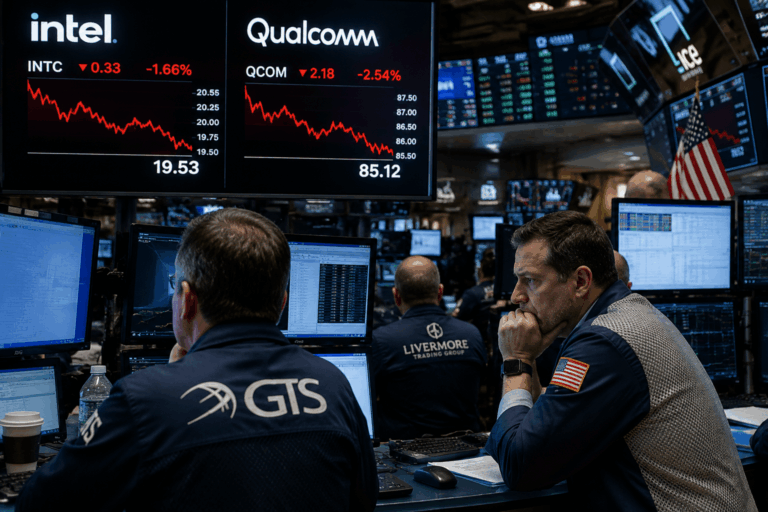
Intel and Qualcomm shares fell sharply on Thursday as investors pulled back from two of the biggest beneficiaries of the artificial intelligence-driven semiconductor rally, while analysts warned that competitive pressures remain intense despite surging enthusiasm around AI infrastructure spending.
Intel shares (INTC) declined nearly 3%, marking a third consecutive day of losses after a rally that has seen the stock more than triple so far this year.
Qualcomm dropped about 4.6%, extending weakness after the smartphone and communications chipmaker hit record highs earlier this week alongside Intel and Advanced Micro Devices.
The stocks witnessed declines despite the S&P 500 being in the green today.
The pullback comes after months of aggressive buying across semiconductor stocks tied to AI servers, cloud infrastructure, and data center expansion.
While analysts said some of the declines likely reflected profit-taking after a historic rally, concerns are also emerging about whether legacy chipmakers can defend market share as AI reshapes the industry.
Server market shifts intensify
UBS analysts said Intel continued to lose ground in the server processor market during the first quarter as rivals AMD and Arm-based chip providers expanded their presence in AI-related workloads.
“Arm and AMD units outgrew and continued to gain share at the expense of Intel,” UBS analyst Timothy Arcuri wrote in a research note this week.
According to UBS estimates, Intel’s share of server CPU units fell roughly 370 basis points to 54.9% during the quarter.
AMD gained 230 basis points to 27.4%, while Arm-based processors increased their share by 140 basis points to 17.7%.
The data highlights how AI computing is rapidly altering the competitive dynamics of the semiconductor market.
Arm-based chips, long dominant in smartphones, are increasingly gaining traction in servers because of their power efficiency and suitability for large-scale AI workloads.
UBS expects that trend to accelerate over the remainder of the decade.
“We believe the Arm instruction set will capture a disproportionate segment of this growth and reach 40-45% share of total units by 2030,” Arcuri wrote.
Even with intensifying competition, analysts expect the server CPU market to expand dramatically as AI adoption increases.
UBS forecasts the total addressable market for server processors will grow from roughly $30 billion in 2025 to $170 billion by 2030.
Deutsche raises PT on Intel but keeps stock on ‘Hold’
Despite market share concerns, some analysts have become more optimistic about Intel’s turnaround prospects.
Earlier this week, Deutsche Bank analyst Ross Seymore raised his price target on Intel to $100 from $63 while maintaining a Hold rating.
The target had already been increased from $45 in late April, reflecting growing confidence that Intel could benefit from rising AI infrastructure demand.
Still, Seymore stopped short of upgrading the stock to a Buy rating, signaling continued caution around the pace and durability of Intel’s recovery.
According to FactSet data, the average analyst target price for Intel stands at $92.60, making Deutsche Bank’s revised estimate among the more optimistic projections on Wall Street.
Qualcomm’s AI ambitions face scrutiny
Qualcomm has also attracted growing investor attention after announcing plans last month to expand deeper into the data center market.
The company disclosed that it had secured a deal with an unnamed hyperscaler customer and plans to begin shipments in the December quarter, raising hopes it could emerge as a meaningful challenger in AI infrastructure chips.
Investors are expected to focus closely on Qualcomm’s upcoming investor day on June 24 for further details about its data center roadmap.
“With the company’s recent datacenter announcements setting up a chance for Qualcomm to silence its critics with a combination of datacenter wins, roadmap announcements, and clarity on how its DC business is setup to be its next $10+ billion annual revenue stream,” Daniel Newman, chief executive officer of The Futurum Group, wrote on X.
“AI demand opened the door for Qualcomm, execution gives it permission to win a share of more than what will be a trillion+ of annual AI chip spend.”
Still, skepticism remains over whether Qualcomm can successfully diversify beyond smartphones while competing against entrenched AI chip players.
Tae Kim, author of “The Nvidia Way,” described Qualcomm as the “problem child of the current chip rally.”
“Qualcomm’s core business is losing share at Apple while the Android market is in trouble,” Kim wrote on Substack.
“Its Windows processor business is about to get shellacked by Nvidia. The company is selling a hope and dream about future data center AI chips and CPUs at a time when there is a massive talent exodus to competitors and startups.”
Charles Hoskinson, founder of Cardano, has been publicly critical of Ripple and XRP in recent months, making claims that the XRP community says are inaccurate.
Hoskinson’s specific claims centred on four points. That Ripple dumps XRP whenever it wants. XRP holders have no ownership stake in Ripple Prime or RLUSD. That there is no staking yield for XRP holders. And that Ripple’s business activities create no meaningful benefit for token holders.
Crypto commentator Max Avery reacted to the same and said Ripple’s XRP holdings are locked in an escrow system with a fixed monthly release schedule that has been publicly verifiable on-chain for years. “It always is kind of perplexing to me when I see people think that Ripple just dumps whenever they feel like it,” Avery said.
The Utility Argument
On whether Ripple’s business benefits XRP holders, Avery framed the connection as structural. XRP serves as a neutral bridge asset in cross-border value transfer with no counterparty risk. Every major Ripple product including RLUSD, Ripple Prime, and cross-border payment infrastructure connects back to the XRP Ledger and drives demand for the token itself.
“The XRP token serving as the neutral bridge asset is ultimately going to lead to an increased value for XRP and increased demand for XRP,” Avery said.
ETF and treasury company inflows support that view. Evernorth and similar XRP treasury vehicles are accumulating tokens off the open market. “There’s been a tremendous amount of interest in XRP despite the FUD, despite people posting stuff about how it’s a scam,” Avery noted. “It’s the same broken record we’ve heard for ten plus years.”
Why Institutions Are Moving Carefully
Avery pushed back on frustration about the pace of institutional adoption with a pointed analogy. “Think of how hard it is for these institutions to change their email service provider, let alone change over something that’s running all of their liquidity and payment infrastructure.”
The challenge is coordination as much as technology. An institution cannot go live with new payment rails if its counterparties are not yet on the same infrastructure. Legal clarity through the CLARITY Act is also a prerequisite many institutions are waiting for before committing fully.
“They’re not going to go fast,” Avery said. “And I think that’s the right decision because I don’t want to go to the bank and be told sorry, we can’t give you any money this week, we screwed up.”
Optical networking stocks extended their strong 2026 rally on Wednesday, with shares of Coherent and Lumentum Holdings climbing alongside broader enthusiasm around artificial intelligence infrastructure demand.
Coherent shares (COHR) rose 7.2%, while Lumentum gained 3.68%.
Applied Optoelectronics surged 10.39%, and Corning added 2.42% as investors continued piling into companies tied to AI data-center buildouts.
All four companies have gained at least 100% so far this year, highlighting investor appetite for businesses supplying optical and networking hardware critical to AI computing infrastructure.
Applied Optoelectronics has led the group with a 440% rally in 2026.
AI infrastructure demand lifts optical networking stocks
The sector’s latest gains did not appear to stem from a single catalyst.
Instead, investors continued to react positively to signs of strengthening demand across the AI data-center ecosystem.
Companies such as Coherent and Lumentum supply optical transceivers and photonic components used to move massive amounts of data between AI servers.
As hyperscale data-center operators expand infrastructure to support generative AI workloads, investors have increasingly focused on suppliers enabling faster data transmission.
Broader semiconductor and optical networking stocks also advanced on Wednesday after concerns emerged around tightening global memory chip supply.
Market sentiment improved further as Nvidia Chief Executive Jensen Huang joined President Donald Trump on his trip to China.
Supply concerns intensified after labor negotiations at Samsung Electronics reportedly collapsed, raising the possibility of additional disruption in the memory chip market.
Trump China visit adds to Coherent momentum
Investor sentiment toward Coherent also received a boost after CEO Jim Anderson joined Trump’s China delegation.
Trump said in a social media post that he would ask China’s Xi Jinping to “‘open up’ China so that these brilliant people can work their magic.”
Separately, Needham highlighted positive commentary from Coherent Chief Marketing Officer Sanjai Parthasarathi following an investor dinner on Tuesday.
According to the research note, the company shipped its first transceiver from its 6-inch fabrication facility, a move expected to improve gross margins compared with earlier-generation products.
The development reinforced optimism that Coherent could strengthen its position in the fast-growing high-speed transceiver market.
BofA raises Coherent price target
BofA Securities raised its price target on the stock to $400 from $365 while maintaining a Neutral rating.
Given 20-30% share in the global transceiver market, we think COHR is best positioned to benefit from higher volumes in 800G/1.6T transceivers, as we contemplate in our new optical model. We raise our PO to $400 from $365, now on 41x CY27 PE on higher estimates vs. 40x prior, higher due to the stronger potential for earnings leverage and share gains as the market increasingly shifts to higher-speed transceivers.
Arya also noted that Coherent could gain additional market share because of its supply advantage in 6-inch substrates, enabling the company to fulfill demand across multiple platforms, including SiPho and EML.
BofA additionally forecast that the total addressable AI data-center market could reach $1.7 trillion by 2030, up from a prior estimate of $1.4 trillion.
XRP has traded within a narrow band between $1.28 and $1.45 for several months, underperforming broader crypto market moves while retail trading volumes on major exchanges have declined. Coinbase XRP trading volume fell 18% year over year, reflecting diminishing retail engagement during the extended consolidation.
The technical constraint is specific. A 1.16 billion token supply overhang sits directly above current prices, representing holders who bought at higher levels and are selling to recover their cost. The wall has absorbed repeated attempts to break higher, creating a mechanical ceiling that has neutralised upward momentum regardless of positive news flow.
The Level That Changes Everything
Technical analysis points to $1.50 as the defining price level. Research reports describe XRP as completing the final stages of a multi-month cup and handle pattern with $1.50 acting as the bull and bear pivot point.
A confirmed break above that level would invalidate the supply overhang and project a measured move toward $1.65 to $1.80, with $1.77 cited as the primary target.
Institutions Are Locking Supply Away
Institutional activity tells a different story to the retail data. Spot ETFs recorded nearly $84 million in inflows during April 2026 alone. Institutional ETFs have collectively locked over 769 million XRP tokens in regulated custody vaults, removing them from liquid circulating supply entirely. Onchain metrics show a 14% year over year increase in transactions involving over one million XRP.
More than 1.2 billion XRP is locked in decentralised liquidity pools on the XRP Ledger. As liquid exchange supply shrinks while institutional demand stays steady, analysts describe a developing squeeze effect that could accelerate price movement sharply once the $1.50 barrier breaks.
The Risk Analysts Are Flagging
The supply wall remains intact until $1.50 breaks with volume confirmation. Without that, the range continues. And the pattern most analysts warn about is already visible. Retail participants tend to wait for large green candles on the news before buying, which is precisely when institutional sellers begin reducing exposure. The positioning window and the public awareness window rarely overlap.
Quantum Computing (QUBT) is ripping higher this morning as investors cheer its solid Q1 results, featuring a massive revenue beat that has effectively silenced long-standing skepticism.
The quantum-tech company posted $3.7 million in revenue for its first quarter, handily exceeding the $3.1 million consensus.
This represents a huge leap from just $39,000 in the same period last year, which is why investors are ignoring a wider operating loss of $20 million today.
Quantum Computing stock is now trading at a year-to-date high of roughly $13.
Quantum Computing stock has an edge over rivals
Beyond immediate earning excitement, QUBT is attractive as a long-term holding because it is a vertically integrated powerhouse.
Unlike many “pure-play” competitors that rely on third-party foundries, Quantum Computing Inc controls its entire production lifecycle.
By maintaining its Arizona-based foundry to manufacture proprietary Thin-Film Lithium Niobate (TFLN) chips, QCi can synchronize hardware architecture with its software suite.
This reduces supply chain dependencies and accelerates the research and development R&D cycle, allowing for “co-design” optimizations that improve machine performance.
For QUBT shares, this means higher entry barriers for competitors and better long-term margins.
Note that management confirmed in the earnings release that QCi Foundry is already contributing to the top-line.
In an industry defined by theoretical potential, the company’s ability to build, program, and scale its own hardware offers a tangible “moat” that is increasingly rare in the quantum landscape.
What else could drive QUBT shares higher in 2026?
The recent acquisitions (Luminar and NuCrypt) have transformed Quantum Computing Inc into a growing force in quantum optics.
Luminar Semiconductor brings world-class laser and detector technology, which – when coupled with NuCrypt’s expertise in quantum security and optical components – suggests QCi has basically internalized the most expensive parts of its bill of materials.
These acquisitions are bullish for Quantum Computing shares because they move the Nasdaq-listed firm closer to commercialization.
By owning the components that power room-temperature quantum systems, QCi is no longer just a computer company; it’s a critical infrastructure provider for the broader photonics industry, with a revenue stream that’s fairly diversified beyond experimental computing.
How to play QCi after its Q1 earnings release?
The most insightful takeaway from QUBT’s first-quarter release was confirmation that its Arizona foundry has transitioned from a pure R&D lab into a revenue-generating asset.
While short-sellers previously attacked the facility’s viability, QCi’s release suggests the hardware is operational.
Plus, management’s intent to open a second facility signals a shift toward high-volume production.
This expansion is a significant green flag for investors, suggesting that demand for the company’s TFLN chips is outstripping current capacity.
Under the steady leadership of CEO Yuping Huang, Quantum Computing is finally providing the operational clarity that was missing in 2025.
With revenue scaling and the infrastructure in place to support a “phygital” quantum future, QUBT stock stands out as a recovery play for the remainder of 2026.