Archive

February 2026

Browsing

The meteoric rise of artificial intelligence, which once propelled markets to record highs, has hit a wall of skepticism.

In early February 2026, a sharp sell-off rippled through global exchanges as the narrative shifted from “AI as a savior” to “AI as a disruptor.”

This volatility was primarily triggered by two factors: a massive spike in capital expenditure from tech giants that has yet to show proportional returns, and the release of highly specialized AI agents capable of automating complex professional tasks.

Investors are no longer just asking who will build the AI, but rather who will be “cannibalized” by it.

Here are the three sectors most at risk.

Enterprise software

For years, the Software-as-a-Service (SaaS) model was the gold standard of steady, recurring revenue.

However, the emergence of autonomous AI agents – like the newly updated Claude Cowork – has sparked what Wall Street is calling the “SaaSpocalypse.”

Investors fear that instead of paying for expensive “per-seat licenses” for CRM or HR tools, firms may simply start using AI to build custom in-house solutions or automate the workflows entirely.

Salesforce (NYSE: CRM) – a longtime industry bellwether – has felt the brunt of this anxiety.

Its stock price plummeted over 15% in a single week following reports that large enterprises were pausing seat-count expansions, opting instead to trial Anthropic’s “AI-powered” automation tools that reduce the need for human software operators.

Commercial real estate services

The real estate sector, particularly firms focused on commercial leasing and property management, has entered a period of deep uncertainty.

The concern is two-fold: AI automation could lead to material white-collar layoffs – reducing the overall demand for office space – and AI tools are beginning to automate “information asymmetry” that real estate brokers rely on for fees.

CBRE Group (NYSE: CBRE) – the world’s largest commercial real estate services firm – saw its shares sank 12% as markets realized that AI can now handle complex lease valuations and market analysis with 99% accuracy.

As investors rotate out of labour-intensive business models, the “high-fee” structures of traditional real estate giants are being viewed as increasingly vulnerable.

Professional information and data services

Sectors that trade on specialized knowledge – legal, accounting, and tax services – are the latest to be swept up in the AI fear trade.

For years, companies like Thomson Reuters and RELX were considered “AI winners” because they owned the data used to train the models.

However, a new wave of vibe coding and specialized legal artificial intelligence agents has shown that the moat provided by proprietary databases may be shrinking.

Thomson Reuters (NASDAQ: TRI) fell over 26% recently as analysts questioned whether AI could now synthesize case law and draft legal filings at a fraction of the cost of the company’s premium subscription services.

The market is currently betting that “democratization of expertise” will hit the bottom line of these data giants far sooner than expected.

The post AI sell-off: 3 sectors it has hit the hardest and why appeared first on Invezz

The post Crypto Rally Alert: Why Bitcoin and Ethereum Prices Are Moving Higher Today appeared first on Coinpedia Fintech News

The cryptocurrency market is showing signs of rallying again, with major assets including Bitcoin and Ethereum posting gains as improving macroeconomic signals and fresh institutional news lift investor sentiment.

Cooling Inflation Sparks Risk-Asset Buying

One of the main drivers behind the latest price increase is the release of softer-than-expected inflation data. U.S. CPI came in at 2.4%, below expectations of 2.5%, reinforcing expectations that inflation pressures may be easing. Lower inflation readings typically improve liquidity expectations and support risk-sensitive assets such as cryptocurrencies, technology stocks, and growth investments.

The broader crypto market capitalization climbed to roughly $2.35 trillion, while the CoinMarketCap 20 index rose more than 2%, reflecting a broad-based recovery across digital assets.

Institutional Sentiment Gets a Boost

The rise was also supported by renewed policy momentum in Brazil, where lawmakers have reintroduced a proposal to establish a strategic national Bitcoin reserve. The move is being viewed by traders as another step toward sovereign-level adoption of digital assets, strengthening long-term institutional confidence in the sector.

Such developments are increasingly influencing short-term price movements, as national-level policy discussions signal expanding recognition of cryptocurrencies within global financial systems.

Extreme Fear Triggers Technical Bounce

Despite the rally, market sentiment indicators still hint at trouble. The Fear and Greed Index remains deep in “extreme fear” territory, historically a level that often precedes contrarian rebounds. At the same time, derivatives open interest has surged, suggesting traders are re-entering positions and covering shorts, helping fuel the current upward move.

Technical analysis also shows that Bitcoin is stabilizing near important support levels. A sustained break above resistance zones could open the door for a stronger upward move, while a failure to hold current support could quickly shift momentum back to the downside.

Market Outlook: Recovery Attempt Underway

For a stronger bullish confirmation, Bitcoin price needs to first break above the recent swing high near $68,400 and then clear the major resistance area around $70,600. A successful move above this level would reduce the risk of further downside and could open the door for a stronger rally in the coming weeks.

For now, the rally appears to be driven by a combination of macro relief, institutional optimism, and technical positioning rather than a full trend reversal. Analysts say the market must hold above recent support levels and attract sustained institutional inflows to confirm a broader recovery phase.

As inflation expectations stabilize and sovereign adoption discussions expand, traders are closely watching whether the current bounce evolves into a stronger market cycle—or remains a short-term relief rally within a still-fragile environment.

CHICAGO — Cardi B was part of Bad Bunny’s Super Bowl halftime show. What she did exactly, well, that turned into a perplexing question for two major prediction markets.

At least one Kalshi trader filed a complaint with the Commodity Futures Trading Commission over how the prediction market handled Sunday’s appearance by the Grammy-winning rapper. The result of a similar event contract on Polymarket also drew the ire of some users on that platform.

Prediction markets provide an opportunity to trade — or wager — on the result of future events. The markets are comprised of typically yes-or-no questions called event contracts, with the prices connected to what traders are willing to pay, which theoretically indicates the perceived probability of an event occurring.

The buy-in for each contract ranges from $0 to $1 each, reflecting a 0% to 100% chance of what traders think could happen.

More than $47.3 million was wagered on Kalshi’s market for “ Who will perform at the Big Game? ” A Polymarket contract had more than $10 million in volume.

Celebrities including Pedro Pascal, Karol G and Cardi B during the Super Bowl halftime show on Sunday.Kevin Mazur / Getty Images for Roc Nation

Cardi B joined singers Karol G and Young Miko and actors Jessica Alba and Pedro Pascal on a starry front porch during the halftime spectacle. She danced to the music, but it was unclear whether she was singing along during the show, which included performances by Ricky Martin and Lady Gaga.

Due to “ambiguity over whether or not Cardi B’s attendance at the 2026 Super Bowl halftime show constituted a qualifying ‘performance,’” Kalshi cited one of its rules in settling the market at the last price before trading was paused: $0.74 for No holders and $0.26 for Yes holders. The platform returned all the money to its users.

Polymarket’s contract was resolved as Cardi B had performed, but the yes was disputed. A final decision on the contract is expected to be announced on Wednesday.

In the CFTC complaint — first reported by the Event Horizon newsletter and posted by Front Office Sports — the trader alleges that Kalshi violated the Commodity Exchange Act with how it resolved the Cardi B contract. The trader — a Yes holder — is seeking $3,700.

A CFTC spokesman declined comment on Wednesday.

The Super Bowl capped a big NFL season for prediction markets.

Kalshi reported a daily record high of more than $1 billion in total trading volume on the day of the game, an increase of more than 2,700% compared to last year’s Super Bowl. The season-long total for all Super Bowl winner futures was $828.6 million, up more than 2,000% from last year.

The increased activity on Sunday caused some deposit issues. Kalshi co-founder Luana Lopes Lara posted on X on Monday that the “traffic spike was way bigger than our most optimistic forecasts.” She said the platform had reimbursed processing fees on the effected deposits and added credits to users who experienced delays.

Robinhood Markets highlighted the strength of its prediction markets when it announced its financial results for the fourth quarter and full 2025 on Tuesday.

“I think we are just at the beginning of a prediction market super cycle that could drive trillions in annual volume over time,” CEO Vlad Tenev said during an earnings call. “This year is going to be a big year. Olympics are going on right now. World Cup coming in the summer.”

This post appeared first on NBC NEWS

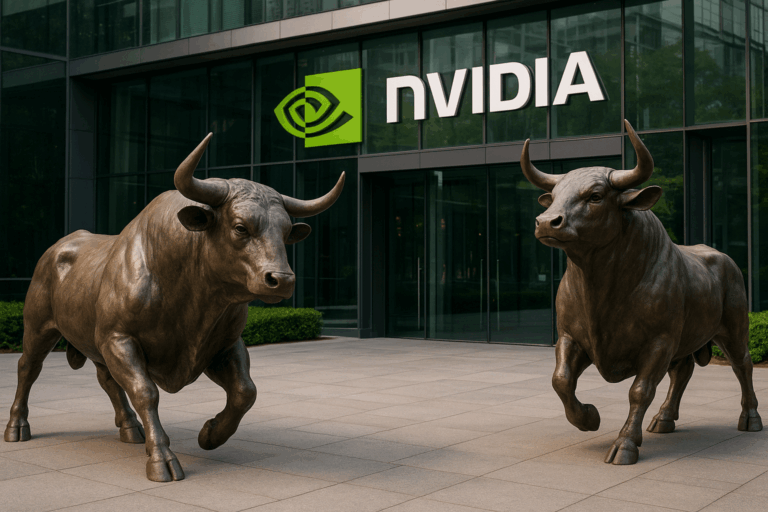
Nvidia stock (NASDAQ: NVDA) slid on Friday as traders locked in gains after a strong stretch that had once again made the AI-chip leader a consensus “crowded” winner.

The move came as part of a broader bout of profit-taking across semiconductors, with the Philadelphia Semiconductor Index also under pressure.

Nvidia stock pullback came as investors weighed rich expectations against a market backdrop that has turned more sensitive to rates, inflation data, and the near-term payoff from the AI boom.

Nvidia stock: Profit-taking and rotation weigh

Friday’s move fit a familiar pattern in momentum stocks, when a widely owned leader stops making fresh highs, investors who bought earlier often sell to protect gains.

That dynamic has been playing out across AI-linked equities, where swings have picked up as traders debate whether Big Tech’s rising capital expenditures translate cleanly into incremental profits.

The bigger context is that Nvidia’s stock performance has cooled even as the AI infrastructure buildout continues.

Nvidia is up less than 1% since the start of the fourth quarter and has been largely range-bound after hitting a record high in late October, a notable slowdown after its nearly 40% rise in 2025.

In other words, investors have been paying up for the story for years, and now they want proof that the next leg of spending can sustain the growth curve.​

Valuation also becomes a louder topic during pullbacks.

Nvidia is at about 24 times forward earnings, close to the Nasdaq 100 and at a slight premium to the S&P 500, while still well below Nvidia’s five-year average multiple of 62-70.

That mix helps explain why the stock can feel “expensive” to some investors and “not obviously cheap” to others, even after bouts of selling.​

Read More: Nvidia stock stuck around $190: HBM costs, China risks are hemming in the AI giant

Analysts weigh in: pause or shift?

Analysts largely described the weakness as a positioning reset, not a fundamental break.

JoAnne Feeney of Advisors Capital Management told Bloomberg that investors are increasingly questioning whether revenue growth can keep up with the scale of capex.​

At the same time, analysts have not been rushing to rewrite their numbers.

Wall Street estimates for Nvidia’s sales and earnings have remained relatively stable since tech giants rolled out their latest spending plans, with many analysts effectively waiting for Nvidia’s own commentary.

That “wait for confirmation” posture can create air pockets in the stock as buyers step back, sellers take profits, and the shares drift until a new catalyst resets expectations.​

The market backdrop is also not helping. ​

For now, Friday’s drop looks like profit-taking layered on top of a market that is re-pricing risk day to day.

The next test is whether Nvidia can re-accelerate sentiment with clear signals on demand and margins, or whether the stock stays range-bound as investors demand stronger evidence that AI capex is translating into durable earnings power.

The post Nvidia stock tumbles over 2%: why investors are booking profits appeared first on Invezz

The post Ethereum Founder Vitalik Buterin Says Paying Users Alone Won’t Save Crypto Apps appeared first on Coinpedia Fintech News

Vitalik Buterin, co-founder of Ethereum, has weighed in on a growing debate within the crypto industry over whether projects must financially reward users to achieve adoption, arguing that incentives can help — but only when used carefully.

His comments came in response to an online discussion claiming that crypto applications cannot attract meaningful usage without airdrops, token rewards or other financial incentives. While Buterin acknowledged that the argument reflects the current realities of the industry, he said the issue is more nuanced than simply “reward users or fail.”

Incentives Can Work — If Used Correctly

Buterin explained that some forms of incentives are economically healthy, particularly when they compensate early adopters for risks associated with using new or experimental platforms. For example, liquidity rewards in decentralized finance (DeFi) can offset the higher technical and security risks that typically exist in early-stage protocols.

In such cases, he said, incentives function as part of a sustainable economic loop rather than a marketing expense.

However, he warned that paying users purely to generate activity, such as incentivizing promotional posts or rewarding users who would not otherwise engage with a mature product, can attract low-quality participation and disappear once payments stop.

Quantity vs. Quality of Users

Buterin warned that aggressive reward campaigns can sometimes create the illusion of adoption while failing to build a committed long-term community. Even if user numbers rise during incentive programs, the overall value of the ecosystem may weaken if participation is driven solely by short-term profit opportunities.

He said that the challenge is particularly important for social or community-driven platforms, where the quality of contributors matters more than the raw number of accounts interacting with the application.

Focus Returning to Real Product Value

According to Buterin, the crypto sector is gradually moving toward a model where long-term success depends less on incentive-driven growth and more on building applications that people genuinely want to use. The most effective incentives, he argued, are those that temporarily compensate for the early disadvantages of a young platform and naturally fade as the product matures.

“The bulk of the effort should be on making an actually useful app,” he wrote, suggesting that the next phase of crypto adoption will favor projects that combine practical utility with carefully designed, targeted incentives rather than relying on broad reward campaigns to attract users.

The operator of roughly 180 Eddie Bauer stores across the U.S. and Canada has filed for Chapter 11 bankruptcy protection, blaming declining sales and a litany of other industry headwinds.

The bankruptcy filing marks the third time in a little over two decades for the storied-but-now-tired brand that began as a Seattle fishing shop, later outfitted the first American to climb Mount Everest and made thousands of newfangled down jackets and sleeping bags for the military during World War II.

Eddie Bauer LLC said Monday it had entered into a restructuring pact with its secured lenders as it made the filing in the U.S. Bankruptcy Court for the District of New Jersey.

Most Eddie Bauer retail and outlet stores in the U.S. and Canada will remain open as the company winds down certain locations. It noted that it will conduct a court-supervised sales process, and if a sale can’t be executed, it will begin a wind-down of its U.S. and Canadian operations.

“This is not an easy decision,” said Marc Rosen, CEO of Catalyst Brands, which maintains the license to operate Eddie Bauer stores in the U.S. and Canada. “However, this restructuring is the best way to optimize value for the retail company’s stakeholders and also ensure Catalyst Brands remains profitable and with strong liquidity and cash flow.”

Eddie Bauer’s stores outside of the U.S. and Canada are operated by other licensees, are not included in the Chapter 11 filings, and will stay open, according to the release.

Authentic Brands Group continues to own the intellectual property associated with the Eddie Bauer brand and may license the brand to other operators, the company said. The operations of other brands in the Catalyst Brands portfolio are not affected by this filing and will continue in the normal course, according to the company.

Eddie Bauer’s e-commerce and wholesale operations will also not be impacted by the wind down, as they are operated by a company called Outdoor 5, LLC. That was a transition it made in January and became effective Feb. 2.

Eddie Bauer joins a growing list of U.S. retailers this year that are closing stores, as companies reorganize under bankruptcy protection or pare down their operations to focus on the most profitable businesses.

The parent company of Saks Fifth Avenue said last month that it was seeking bankruptcy protection, buffeted by rising competition and the massive debt it took on to buy its rival in the luxury sector, Neiman Marcus, just over a year ago. A few days later, the parent company said it was closing most of its Saks Off 5th stores.

Amazon said earlier this month that it was closing almost all of its Amazon Go and Amazon Fresh locations within days as it narrows its focus on food delivery and its grocery chain, Whole Foods Market.

Eddie Bauer’s namesake founder — an avid outdoorsman — started the company in Seattle in 1920 as Bauer’s Sports Shop, according to the brand’s website. In 1945, after making more than 50,000 jackets for the military, it launched a mail-order catalog.

“Bauer’s Sports Shop was not just a place where people purchased clothing and gear, it was a community hub where folks gathered to share their wisdom, learn, and talk about their experiences in the outdoors,” the website says.

The company created an American goose-down insulated jacket, known as the “Skyliner,” in 1936, and it became the company’s first patented jacket. It also outfitted the first American to climb Mount Everest — James W. Whittaker — with an Eddie Bauer parka in 1963.

After Bauer retired in 1968 and sold the business to his partner, the outdoor brand shifted more toward casual apparel and was bought by General Mills Inc. in 1971 and then by Spiegel Inc. in 1988. After Spiegel filed for bankruptcy in 2003 and most of its assets were sold, the remainder of the company was reorganized in 2005 as Eddie Bauer Holdings Inc.

In June 2009, Eddie Bauer filed bankruptcy and was acquired by Golden State Capital, the following month. In 2021, it was acquired by Authentic Brands and SPARC Group LLC.

A year ago, Catalyst was formed by the merger of SPARC and JCPenney, which Simon Property Group and fellow mall landlord Brookfield bought out of bankruptcy.

Rosen noted that even prior to the inception of Catalyst Brands last year, Eddie Bauer was in a “challenged situation.”

“Over the past year, these challenges have been exacerbated by various headwinds, including increased costs of doing business due to inflation, ongoing tariff uncertainty, and other factors,” he said.

He noted that while Catalyst’s leadership was able to make improvements in product development and marketing, those changes could not be implemented fast enough to fully address the problems created over several years.

Eddie Bauer had nearly 600 stores at its peak in 2001, according to CoStar Group Inc., a commercial real estate data firm.

In a note published earlier this month, Neil Saunders, managing director of GlobalData Retail, wrote that while the Eddie Bauer name is “well known,” the brand hasn’t kept pace with rivals like Swedish outdoor brand Fjallraven and Canadian label Arc’teryx. He also cited issues with quality deteriorating, which, for an outdoor brand measured by the performance of its products, is very problematic.

“And for many younger shoppers, the brand is seen as somewhat old-fashioned and a bit irrelevant,” he said.

This post appeared first on NBC NEWS

Nvidia stock moved higher in early trading on Thursday, with the chipmaker once again testing the upper end of its recent range as investors positioned ahead of its earnings report later this month.

Nvidia shares were up 0.8% at $191.11. The Nvidia stock has climbed 11% over the past five trading sessions but has largely traded sideways since November.

The surge today comes even as other AI stocks such as Meta, Microsoft and Amazon were struggling at the bourses.

Chinese AI stocks rally on model upgrades

At the same time, artificial intelligence-related shares in China posted strong gains on Thursday after several companies unveiled upgraded models.

Hong Kong-listed Zhipu AI, which trades as Knowledge Atlas Technology, surged nearly 30% to close at 405 Hong Kong dollars after releasing GLM-5, an open-source large-language model featuring enhanced coding capabilities and longer-running agent tasks.

Shares of MiniMax jumped 14% to 70.5 Hong Kong dollars following the launch of its updated M2.5 open-source model, which includes expanded AI agent tools.

The company described its M2 model as built for coding and agentic workflows.

Shanghai-listed UCloud Tech, which provides computing support for Zhipu, rose 20% to hit its daily trading limit.

Meanwhile, SenseTime, which has shifted its focus toward AI software platforms, gained 6.8% in Hong Kong trading.

According to the South China Morning Post, DeepSeek upgraded its flagship AI model on Wednesday to support a larger context window and more up-to-date knowledge.

US lawmaker signals flexibility on China chip sales

In Washington, debate over chip exports resurfaced as Ro Khanna, the ranking member on the House Select Committee on China, indicated he may support allowing sales of older-generation Nvidia chips to China.

Speaking to reporters after his first committee hearing, Khanna suggested that once the US establishes a technological lead, certain older chips could be sold abroad while restricting access to the latest products.

“We certainly shouldn’t be sending them Rubins. We shouldn’t be sending them Blackwells,” Khanna said.

“But after we have a two-year, three-year advantage, then I’m fine to make sure that our chips are being used in refrigerators and dishwashers and that that is something that we’re selling.”

Earnings and guidance in focus

Investors are now looking to the company’s January-quarter results, scheduled for release on February 25, for a potential catalyst.

According to a FactSet survey of analysts, Nvidia is expected to report adjusted earnings of $1.49 per share on revenue of $65.58 billion.

While the headline numbers are closely watched, forward guidance is likely to be the key driver of the stock’s next move.

Timothy Arcuri of UBS wrote this week that investor expectations for Nvidia’s April quarter may already be running ahead of consensus estimates.

He suggested that the market likely expects revenue in the $74 billion to $75 billion range, compared with the current FactSet consensus forecast of $71.59 billion.

The gap underscores the high bar facing Nvidia after years of rapid growth tied to artificial intelligence infrastructure spending.

The post Why Nvidia stock is up around 1% while other AI giants struggle appeared first on Invezz

The post Ripple CEO Calls XRP the ‘North Star’ and ‘Heartbeat’ of Company, Reveals What Comes Next appeared first on Coinpedia Fintech News

At the opening of XRP Community Day 2026, Brad Garlinghouse, CEO of Ripple, delivered a strong message to the global community, describing XRP as the “north star” and “heartbeat” of Ripple’s long-term strategy.

A celebration of the XRP community

Garlinghouse began his speech by welcoming XRP holders, developers, and partners from around the world, calling the event a celebration of the people building and supporting the ecosystem. He said the growth of XRP has been driven not only by technology but also by the strength of its global community.

XRP remains central to Ripple’s institutional strategy

According to Garlinghouse, XRP continues to guide Ripple’s institutional expansion. He explained that Ripple is focused on:

  • Expanding liquidity around XRP
  • Increasing real-world financial use cases
  • Strengthening enterprise adoption of the XRP Ledger
  • Building more on-chain financial infrastructure

He emphasized that institutions are increasingly looking for fast, low-cost cross-border payment solutions, and XRP remains a key part of that effort.

Ripple’s long-term vision toward 2030

Looking ahead, Garlinghouse said Ripple aims to grow into a global financial platform company by 2030, offering a wider range of infrastructure services while continuing to build trust across its ecosystem. He noted that utility, liquidity, and real-world adoption of XRP will remain at the center of the company’s mission.

The takeaway

Garlinghouse’s remarks reinforced Ripple’s commitment to XRP as a core part of its future, signaling that upcoming initiatives will focus heavily on expanding institutional usage and strengthening the real-world role of the XRP Ledger in global finance.

LOS ANGELES — The world’s biggest social media companies face several landmark trials this year that seek to hold them responsible for harms to children who use their platforms. Opening statements for the first, in Los Angeles County Superior Court, begin this week.

Instagram’s parent company Meta and Google’s YouTube will face claims that their platforms deliberately addict and harm children. TikTok and Snap, which were originally named in the lawsuit, settled for undisclosed sums.

“This was only the first case — there are hundreds of parents and school districts in the social media addiction trials that start today, and sadly, new families every day who are speaking out and bringing Big Tech to court for its deliberately harmful products,” said Sacha Haworth, executive director of the nonprofit Tech Oversight Project.

At the core of the case is a 19-year-old identified only by the initials “KGM,” whose case could determine how thousands of other, similar lawsuits against social media companies will play out. She and two other plaintiffs have been selected for bellwether trials — essentially test cases for both sides to see how their arguments play out before a jury and what damages, if any, may be awarded, said Clay Calvert, a nonresident senior fellow of technology policy studies at the American Enterprise Institute.

It’s the first time the companies will argue their case before a jury, and the outcome could have profound effects on their businesses and how they will handle children using their platforms.

KGM claims that her use of social media from an early age addicted her to the technology and exacerbated depression and suicidal thoughts. Importantly, the lawsuit claims that this was done through deliberate design choices made by companies that sought to make their platforms more addictive to children to boost profits. This argument, if successful, could sidestep the companies’ First Amendment shield and Section 230, which protects tech companies from liability for material posted on their platforms.

“Borrowing heavily from the behavioral and neurobiological techniques used by slot machines and exploited by the cigarette industry, Defendants deliberately embedded in their products an array of design features aimed at maximizing youth engagement to drive advertising revenue,” the lawsuit says.

Executives, including Meta CEO Mark Zuckerberg, are expected to testify at the trial, which will last six to eight weeks. Experts have drawn similarities to the Big Tobacco trials that led to a 1998 settlement requiring cigarette companies to pay billions in health care costs and restrict marketing targeting minors.

“Plaintiffs are not merely the collateral damage of Defendants’ products,” the lawsuit says. “They are the direct victims of the intentional product design choices made by each Defendant. They are the intended targets of the harmful features that pushed them into self-destructive feedback loops.”

The tech companies dispute the claims that their products deliberately harm children, citing a bevy of safeguards they have added over the years and arguing that they are not liable for content posted on their sites by third parties.

“Recently, a number of lawsuits have attempted to place the blame for teen mental health struggles squarely on social media companies,” Meta said in a recent blog post. “But this oversimplifies a serious issue. Clinicians and researchers find that mental health is a deeply complex and multifaceted issue, and trends regarding teens’ well-being aren’t clear-cut or universal. Narrowing the challenges faced by teens to a single factor ignores the scientific research and the many stressors impacting young people today, like academic pressure, school safety, socio-economic challenges and substance abuse.”

A Meta spokesperson said in a recent statement that the company strongly disagrees with the allegations outlined in the lawsuit and that it’s “confident the evidence will show our longstanding commitment to supporting young people.”

José Castañeda, a Google Spokesperson, said that the allegations against YouTube are “simply not true.” In a statement, he said, “Providing young people with a safer, healthier experience has always been core to our work.”

The case will be the first in a slew of cases beginning this year that seek to hold social media companies responsible for harming children’s mental well-being.

In New Mexico, opening statements begin Monday for trial on allegations that Meta and its social media platforms have failed to protect young users from sexual exploitation, following an undercover online investigation. Attorney General Raúl Torrez in late 2023 sued Meta and Zuckerberg, who was later dropped from the suit.

Prosecutors have said that New Mexico is not seeking to hold Meta accountable for its content but rather its role in pushing out that content through complex algorithms that proliferate material that can be harmful, saying they uncovered internal documents in which Meta employees estimate that about 100,000 children every day are subjected to sexual harassment on the company’s platforms.

Meta denies the civil charges while accusing Torrez of cherry-picking select documents and making “sensationalist” arguments. The company says it has consulted with parents and law enforcement to introduce built-in protections to social media accounts, along with settings and tools for parents.

A federal bellwether trial beginning in June in Oakland, California, will be the first to represent school districts that have sued social media platforms over harms to children.

In addition, more than 40 state attorneys general have filed lawsuits against Meta, claiming it is harming young people and contributing to the youth mental health crisis by deliberately designing features on Instagram and Facebook that addict children to its platforms. The majority of cases filed their lawsuits in federal court, but some sued in their respective states.

TikTok also faces similar lawsuits in more than a dozen states.

This post appeared first on NBC NEWS

Unity Software (NYSE: U) cratered another 30% in premarket today after the game software firm came in ahead of Q4 estimates but disappointed investors with a tepid current quarter guidance.

In its earnings release, the company guided for $485 million in revenue – well below $494 million that analysts had called for – shattering hopes of a meaningful recovery this year.

U shares rallied nearly 40% in the final quarter of 2025, only to be hit first by “Project Genie” and now a downbeat guidance, which leaves investors questioning if Unity stock is now a “value trap”.

Should you buy Unity stock on the post-earnings dip?

Investors are cautioned against buying the post-earnings dip in Unity shares because of a structurally high operating cost base that refused to shrink despite multiple rounds of layoffs.

While the management blamed sales initiatives and the Unite conference for a $89 million “net loss” in the fourth quarter, its Q1 outlook suggests things aren’t going to be meaningfully better moving forward.

At a toned-down price-to-sales (P/S) ratio of about “6.68”, U stock sure looks attractive – but that multiple may not mean much if the company can’t convert its “massive market share” into actual, unadjusted net income.

A significant decline in free cash flow margin from 32.1% to 23.6% reinforces fears that Unity is running harder just to stay in the same place.

SaaSpocalypse remains an overhang for U shares

Google’s recent launch of “Project Genie” acted as a harbinger of the competitive pressures Unity Software faces in an artificial intelligence (AI) native world.

While Matt Bromberg, its chief executive, argues that AI world-builders lack the “determinism” of a professional engine, the market seems to be pricing in a future where the barrier to entry in game development is much lower.

If Google, or any other hyperscaler for that matter, eventually bypasses traditional “Create” workflow with generative models, Unity’s dominance in mobile gaming (where it powers some 70% of titles) becomes a liability rather than a moat.  

In short, the concern is that Unity shares are caught in a “SaaSpocalypse” pincer move: its legacy tools are being disrupted by AI, while its own artificial intelligence offerings like “Vector” face fierce competition from nimbler ad-tech rivals like AppLovin.

How to play Unity Software after Q4 earnings?

Finally, it’s reasonable to treat U stock as a value trap also because the firm’s Q1 outlook suggests the reset is taking much longer than anticipated.

While newer products like Unity 6 show promise, the company is still being dragged down by its legacy portfolio, including the declining assets from the ironSource merger.

With Unity’s guidance for up to $110 million in adjusted EBITDA this quarter, also falling short of the $112 million consensus, the stock remains unattractive, given structural headwinds seem to be offsetting its positive catalysts in 2026.

U now sits decisively below its major moving averages (MAs), reinforcing that a near-term bounce is unlikely.

For those looking to “buy the dip” in Unity shares, therefore, the risk is that it may not be a temporary discount, but a permanent repricing of a company that’s lost its premium status.

The post Unity stock crashes on Q4 earnings: is it a ‘value trap’? appeared first on Invezz