
Archive

April 13, 2026

Browsing

The post Ondo Finance’s SEC Filing Could Open Doors for Tokenized Securities on Ethereum appeared first on Coinpedia Fintech News

Ondo Finance has filed a no-action request with the US Securities and Exchange Commission seeking confirmation that recording securities entitlements on Ethereum Mainnet will not trigger enforcement action – a filing that arrives less than five months after the SEC closed a two-year investigation into the company without charges.

The request marks a significant shift in the relationship between one of the largest tokenized asset platforms and its regulator.

What Ondo Is Asking the SEC to Confirm

The filing relates specifically to Ondo Global Markets, the company’s product that gives non-US investors exposure to US-listed stocks and ETFs through tokenized notes. Ondo is not asking the SEC to rewrite securities law or approve tokenized securities broadly.

The request is narrow: confirmation that SEC staff would not recommend enforcement action if the company proceeds with recording certain securities entitlements in tokenized form on Ethereum Mainnet, held by custodian BitGo.

“The underlying securities would remain inside the existing legal, custody, and recordkeeping framework, and the official books and records would remain there as well,” Ondo wrote in its filing.

The practical purpose is operational. The on-chain layer would support cleaner collateral monitoring, more efficient creation-and-redemption workflows and simpler reconciliation for OGM products. The core legal structure of the product does not change.

Why the Filing Sets a Precedent

A no-action letter does not create new regulation. What it creates is documented confirmation that a specific, bounded model can proceed without waiting for a formal rulemaking process – and in doing so, establishes a template for the broader RWA tokenization industry.

If SEC staff approve the model, it would represent the first formal regulatory confirmation that public blockchain infrastructure can function within the US securities recordkeeping system. Every other tokenization firm operating in this space would have a direct reference point.

The SEC under chair Paul Atkins has moved away from the enforcement-first posture of his predecessor. The agency closed its investigation into Ondo in December 2025, and has since publicly backed tokenization as a capital markets innovation.

ONDO Price Today

The token is trading at $0.25, up 2.83% over the past 24 hours, with platform TVL at $3.55 billion. ONDO remains 88% below its all-time high of $2.14.

The SEC has not yet responded to the filing.
Nvidia shares remained flat at $188.55 in early trading Monday, struggling to break out of a months-long trading range.

The stock had closed 2.6% higher on Friday, marking its eighth consecutive session of gains.

Broader markets were mixed. The Nasdaq Composite rose 0.3%, while the Dow Jones Industrial Average fell 267 points, or 0.6%.

Nvidia received a lift last week after Taiwan Semiconductor Manufacturing Company reported stronger-than-expected sales.

The chip foundry posted a 39% increase in quarterly revenue to $36 billion, beating estimates of $35 billion.

TSMC is set to report its full first-quarter results later this week.

Despite the positive read-through, Nvidia shares have struggled to regain levels above $200.

Geopolitical risks weigh on outlook

Ongoing tensions in the Middle East continue to cloud the outlook.

Concerns around the Iran conflict and the disruption of the Strait of Hormuz are raising fears about supply chain stability.

Much of Asia’s semiconductor ecosystem depends on energy shipments routed through the Strait, which remains effectively blocked.

Rising energy costs and potential shortages of key inputs such as helium are adding to uncertainty.

TSMC, a key supplier to Nvidia, is particularly exposed.

The company accounts for about 9% of Taiwan’s electricity consumption, with natural gas as the primary energy source.

Authorities have said liquefied natural gas reserves are sufficient through May, but risks remain.

Competition intensifies in AI chips

Beyond geopolitics, competitive pressures are building.

Amazon CEO Andy Jassy said the company could expand sales of its in-house AI chips to third parties, potentially increasing competition with Nvidia.

Chinese technology giant Huawei has also stepped up its efforts.

The company said its Ascend 950PR processor delivers nearly 2.87 times the performance of Nvidia’s H200 AI chip.

Nvidia has resumed production of its H200 chips for Chinese customers, though it did not provide detailed guidance on China sales.

The competitive landscape is further complicated by policy developments.

China had earlier encouraged domestic customers to shift toward local chip suppliers, while US tariffs have added complexity to global semiconductor trade.

At the same time, supply-side challenges are emerging.

KeyBanc analyst John Vinh said Nvidia could face difficulties scaling production of its next-generation Vera Rubin chips.

Vinh noted that shortages of high-bandwidth memory could force Nvidia to reduce planned output in 2026 to around 1.5 million units from an earlier estimate of 2 million.

He maintains an Overweight rating on the stock with a $275 price target.

Long-term outlook remains strong

Despite near-term concerns, Nvidia continues to project strong long-term growth.

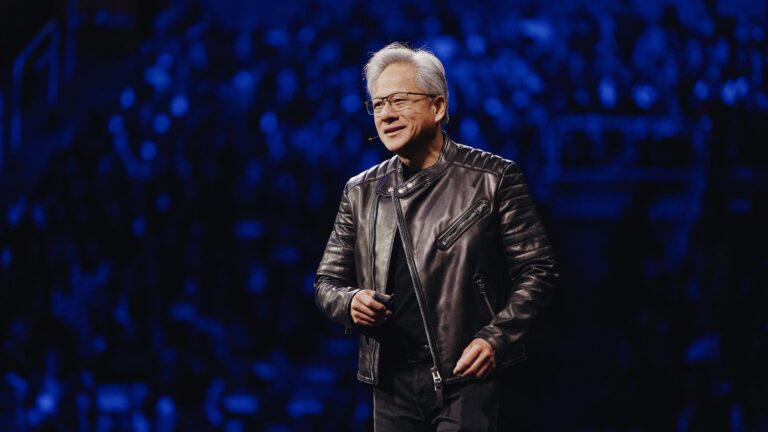
At its GTC event in March, CEO Jensen Huang said sales from its Blackwell and Vera Rubin chips could reach $1 trillion by 2027, doubling previous forecasts.

The outlook underscores Nvidia’s central role in the AI ecosystem, even as investors weigh risks related to geopolitics, competition, and supply constraints.

For now, the stock remains caught between strong structural demand and near-term uncertainties, limiting its ability to break out of its recent trading range.

The post Nvidia stock jittery on Monday: why the AI darling is struggling to breakout appeared first on Invezz