GameStop launches Power Packs tomorrow, April 15. Available at powerpacks.com, Power Packs is a digital pack opening platform built in partnership with PSA, the world’s largest and most trusted trading card grading company, and it comes with something no other platform in this space has ever offered at launch.
Packs are available across four categories at launch: Pokemon, football, basketball, and baseball. Entry level packs start at $25 and go up to $2,500 for premium offerings, meaning there is a price point for the casual collector opening their first pack and the serious investor looking to pull something significant.
How Power Packs Actually Works
You purchase a digital pack on powerpacks.com and open it in real time, seeing exactly which cards you pulled as it happens. From that moment, every card lives in the PSA Vault, authenticated and graded, with three options available to you immediately. You can sell it back instantly, have it shipped directly to your home, or hold it in your digital inventory and decide later.
That last part matters more than it sounds. The ability to sell back instantly is not a feature most platforms offer because most platforms cannot offer it. When a card is already PSA graded and sitting in a verified vault, it has a known condition and therefore a knowable market value. That makes instant liquidity possible in a way it has never been before for the average collector.
The Problem This Solves That Nobody Talks About
The trading card market has a friction problem that has quietly cost collectors enormous amounts of money for years. You pull a valuable card. You want to sell it. But a raw ungraded card sells for a fraction of what a PSA graded version commands. So you pay for grading, wait anywhere from weeks to months depending on the service tier, hope the grade comes back what you expected, and then sell on a secondary market that takes fees, charges shipping, and introduces counterparty risk at every step.
Power Packs removes those steps. The grading is done. The authentication is done. The storage is handled. The exit is immediate. For a collector who has been burned by the gap between pulling something exciting and actually turning it into money, that is not a minor convenience upgrade. That is a structural fix to a market that has needed one for a long time.
The trading card market is valued at roughly $15 billion and has seen explosive growth since 2020. Whether it delivers on that promise becomes clear tomorrow.
Billionaire investor Ken Griffin has warned that a prolonged shutdown of the Strait of Hormuz could push the global economy into a recession, underscoring the risks tied to ongoing tensions in the Middle East.
Speaking at the Semafor World Economy Forum, the founder and CEO of Citadel described the situation as a critical inflection point for global markets, particularly due to the region’s central role in energy supply.
“This really is a very, very treacherous moment for the world economy,” Griffin said. “From a macroeconomic perspective around the world…the key criteria is the resumption of the continued flow of energy products from the Middle East without tolls, without harassment.”
Energy flows at the heart of recession risks
Griffin emphasized that the uninterrupted flow of oil and energy products through the Strait remains essential for global economic stability. A disruption lasting several months could have severe consequences.
“Let’s assume [the Strait is] shut down for the next six to 12 months — the world’s going to end up in a recession. There’s no way to avoid that,” he said.
Oil prices have already reacted to the geopolitical uncertainty, hovering around $100 a barrel—well above pre-conflict levels of just under $70.
While prices have eased from their peak during the conflict, they remain elevated, posing risks to consumption and growth, particularly in energy-dependent economies across Asia.
Markets rebound, but risks remain underpriced
Despite the geopolitical tensions, equity markets have shown resilience. Stocks have largely rebounded to levels seen before the United States first launched strikes on Iran earlier this year.
However, Griffin cautioned that investor optimism may be fragile and heavily dependent on how the conflict evolves.
The current market sentiment, he noted, assumes that tensions will not escalate significantly or disrupt energy flows for an extended period. Many investors, however, believe that the risk of further escalation between the US and Iran is not fully reflected in asset prices.
This disconnect raises concerns that markets could react sharply if the situation deteriorates or if supply disruptions intensify.
War impact and shift toward alternative energy
Griffin also struck a nuanced tone on the broader geopolitical context, including the decision by Donald Trump to authorize strikes on Iran. He noted that many observers had underestimated the resilience of Iran’s military capabilities.
“We have effectively destroyed every single target you can strike from the sky,” he said, while adding that the Iranian military “is still very much intact.”
At the same time, Griffin suggested that delaying military action could have led to even more severe consequences, particularly given advances in Iran’s missile technology.
“Despite what we’re seeing today, if it had happened later, it could actually be much worse,” he said, adding that Trump made a “very difficult decision about what to do right here, right now. The history has been forever changed.”
Looking ahead, Griffin pointed to a potential long-term shift in global energy strategy. A prolonged disruption in Middle Eastern oil supply could accelerate investment in alternative energy sources such as wind, solar, and nuclear power, as countries seek to reduce dependence on volatile supply routes.
Ondo Finance has filed a no-action request with the US Securities and Exchange Commission seeking confirmation that recording securities entitlements on Ethereum Mainnet will not trigger enforcement action – a filing that arrives less than five months after the SEC closed a two-year investigation into the company without charges.
The request marks a significant shift in the relationship between one of the largest tokenized asset platforms and its regulator.
What Ondo Is Asking the SEC to Confirm
The filing relates specifically to Ondo Global Markets, the company’s product that gives non-US investors exposure to US-listed stocks and ETFs through tokenized notes. Ondo is not asking the SEC to rewrite securities law or approve tokenized securities broadly.
The request is narrow: confirmation that SEC staff would not recommend enforcement action if the company proceeds with recording certain securities entitlements in tokenized form on Ethereum Mainnet, held by custodian BitGo.
“The underlying securities would remain inside the existing legal, custody, and recordkeeping framework, and the official books and records would remain there as well,” Ondo wrote in its filing.
The practical purpose is operational. The on-chain layer would support cleaner collateral monitoring, more efficient creation-and-redemption workflows and simpler reconciliation for OGM products. The core legal structure of the product does not change.
Why the Filing Sets a Precedent
A no-action letter does not create new regulation. What it creates is documented confirmation that a specific, bounded model can proceed without waiting for a formal rulemaking process – and in doing so, establishes a template for the broader RWA tokenization industry.
If SEC staff approve the model, it would represent the first formal regulatory confirmation that public blockchain infrastructure can function within the US securities recordkeeping system. Every other tokenization firm operating in this space would have a direct reference point.
The SEC under chair Paul Atkins has moved away from the enforcement-first posture of his predecessor. The agency closed its investigation into Ondo in December 2025, and has since publicly backed tokenization as a capital markets innovation.
ONDO Price Today
The token is trading at $0.25, up 2.83% over the past 24 hours, with platform TVL at $3.55 billion. ONDO remains 88% below its all-time high of $2.14.
Nvidia shares remained flat at $188.55 in early trading Monday, struggling to break out of a months-long trading range.
The stock had closed 2.6% higher on Friday, marking its eighth consecutive session of gains.
Broader markets were mixed. The Nasdaq Composite rose 0.3%, while the Dow Jones Industrial Average fell 267 points, or 0.6%.
Nvidia received a lift last week after Taiwan Semiconductor Manufacturing Company reported stronger-than-expected sales.
The chip foundry posted a 39% increase in quarterly revenue to $36 billion, beating estimates of $35 billion.
TSMC is set to report its full first-quarter results later this week.
Despite the positive read-through, Nvidia shares have struggled to regain levels above $200.
Geopolitical risks weigh on outlook
Ongoing tensions in the Middle East continue to cloud the outlook.
Concerns around the Iran conflict and the disruption of the Strait of Hormuz are raising fears about supply chain stability.
Much of Asia’s semiconductor ecosystem depends on energy shipments routed through the Strait, which remains effectively blocked.
Rising energy costs and potential shortages of key inputs such as helium are adding to uncertainty.
TSMC, a key supplier to Nvidia, is particularly exposed.
The company accounts for about 9% of Taiwan’s electricity consumption, with natural gas as the primary energy source.
Authorities have said liquefied natural gas reserves are sufficient through May, but risks remain.
Competition intensifies in AI chips
Beyond geopolitics, competitive pressures are building.
Amazon CEO Andy Jassy said the company could expand sales of its in-house AI chips to third parties, potentially increasing competition with Nvidia.
Chinese technology giant Huawei has also stepped up its efforts.
The company said its Ascend 950PR processor delivers nearly 2.87 times the performance of Nvidia’s H200 AI chip.
Nvidia has resumed production of its H200 chips for Chinese customers, though it did not provide detailed guidance on China sales.
The competitive landscape is further complicated by policy developments.
China had earlier encouraged domestic customers to shift toward local chip suppliers, while US tariffs have added complexity to global semiconductor trade.
At the same time, supply-side challenges are emerging.
KeyBanc analyst John Vinh said Nvidia could face difficulties scaling production of its next-generation Vera Rubin chips.
Vinh noted that shortages of high-bandwidth memory could force Nvidia to reduce planned output in 2026 to around 1.5 million units from an earlier estimate of 2 million.
Despite near-term concerns, Nvidia continues to project strong long-term growth.
At its GTC event in March, CEO Jensen Huang said sales from its Blackwell and Vera Rubin chips could reach $1 trillion by 2027, doubling previous forecasts.
The outlook underscores Nvidia’s central role in the AI ecosystem, even as investors weigh risks related to geopolitics, competition, and supply constraints.
For now, the stock remains caught between strong structural demand and near-term uncertainties, limiting its ability to break out of its recent trading range.
Crypto in the last 24 hours just got a jolt that changes everything. Japan’s cabinet approved a landmark bill on April 10 reclassifying crypto as financial instrument on par with stocks and bonds, banning insider trading and requiring annual disclosures, according to CoinDesk. When the world’s third largest economy treats crypto like traditional securities, the capital that follows makes every early entry more valuable.
Pepeto follows that same conviction at presale pricing, past $8.92 million raised with live tools shipped before the first wallet committed and a Binance listing on the horizon that makes the projected growth real. This crypto in the last 24 hours breakdown covers what Japan’s move signals and why wallets keep entering Pepeto during extreme fear.
Crypto in the Last 24 Hours Reveals Japan Puts Crypto on Par With Stocks
Japan’s cabinet approved amendments to the Financial Instruments and Exchange Act on April 10, officially classifying crypto as financial instruments for the first time, according to CoinDesk. The bill bans insider trading, requires annual disclosures from issuers, and raises penalties for unregistered sellers to 10 years in prison.
The move opens the door to crypto ETFs in Japan and a proposed tax cut from 55% to 20% on crypto gains, according to Yahoo Finance. Crypto in the last 24 hours proves that regulatory clarity is accelerating, not slowing down, and the projects with live products and confirmed listings are where that wave lands first.
What Japan’s Regulatory Shift and One Presale Tell You About Where Real Gains Come From
Pepeto
The biggest cost this cycle is not bad trades. It is entering a token that looked real until the contract drained your wallet. A risk engine that scans every token and blocks the threat before your money touches it is the fix most platforms still do not offer. Pepeto already runs this on every trade.
The bridge handles cross-chain transfers between Ethereum, BNB Chain, and Solana at zero cost. PepetoSwap runs every swap without fees so the entry you commit to is the entry you hold.
Over $8.92 million arrived at $0.0000001863 from wallets that checked the SolidProof audit and verified the founder behind Pepe’s $11 billion run before committing during Fear 14. Staking at 185% APY builds your position while the listing draws closer, but the Binance listing itself is the event that turns this entry into the returns analysts project. That return only goes to the wallets that acted while the entry was still open, and the listing can land at any moment.
Solana (SOL) Price at $85 as Active Wallets Drop While Japan Opens New Doors
Solana (SOL) trades at $85 on April 11, down 72% from its $293 high while active addresses fell 11% in 30 days, according to CoinMarketCap.
SOL ETFs posted three straight weeks of outflows totaling $17 million despite Japan’s regulatory boost. On-chain activity keeps fading, breaking the case that ETF inflows alone fix price. A break above $90 shifts the picture, but from $85 a double still takes months and billions that crypto in the last 24 hours shows are not arriving for altcoins.
BNB Price at $607 as Burns Hold the Floor but Japan’s Shift Does Not Lift the Ceiling
BNB trades at $607 on April 11, the steadiest large cap in the crypto in the last 24 hours while the broader market digests Japan’s announcement, according to CoinMarketCap.
BNB benefits from exchange revenue and token burns, but an $88 billion cap means a 2x needs capital that took years to build the first time. For wallets that want returns counted in multiples, the gap between BNB’s ceiling and Pepeto’s confirmed listing is where this cycle’s real math lives.
Conclusion
While Solana (SOL) and BNB grind sideways, every crypto in the last 24 hours signal points to the same thing. Japan just told the world that crypto belongs in the same category as stocks and bonds, and the projects with live tools, audits, and confirmed listings are the ones that benefit first. Pepe went from nothing to a multi billion dollar cap with zero products, and the people who acted early still say they did not buy enough.
The same pattern forms around Pepeto now, and $8.92 million flowing during Fear 14 proves the wallets inside already calculated the outcome. The Pepeto official website is where smart capital commits right now, and the presale closes once the Binance listing goes live. You move on the signal or you carry the cost of waiting.
What does the crypto in the last 24 hours show after Japan reclassified crypto as financial instruments?
Japan treating crypto like stocks opens doors for ETFs and institutional capital. Pepeto has $8.92 million raised and a Binance listing approaching during Fear 14.
Can Solana or BNB deliver presale-level returns from current prices after Japan’s move?
SOL at $85 and BNB at $607 need years of capital inflows for a 2x. Pepeto at presale pricing delivers 100x from a single Binance listing.
US small-cap stocks are staging a notable comeback in 2026, outperforming their large-cap peers after years of lagging returns, as sector dynamics, valuation resets, and improving earnings prospects reshape market leadership.
So far this year, small caps have outperformed large caps by 8.5 percentage points, marking a sharp reversal after roughly six years of underperformance.
The shift comes amid broader changes in investor positioning, with capital rotating away from large technology stocks and toward more cyclical and undervalued segments of the market.
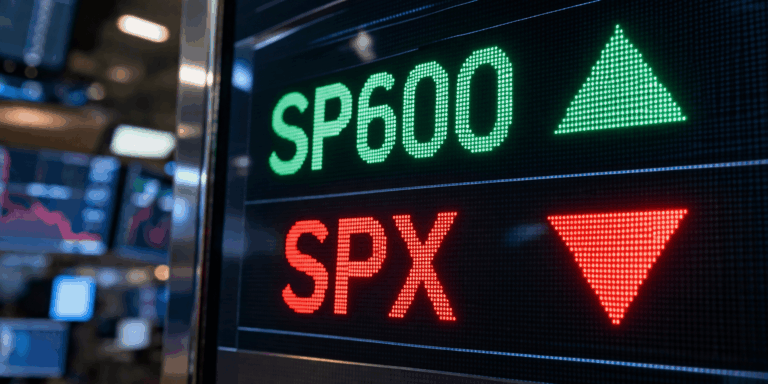
The S&P SmallCap 600 Index has gained 6.8% in the year so far, while the S&P 500 in the same time is down 0.49%.
Sector dynamics tilt in favor of small caps
A key driver of the outperformance has been sector composition. Energy, the best-performing sector this year, carries a larger weight in small-cap indices than in large-cap benchmarks.
It accounts for 6.5% of the S&P 600 small-cap index compared with 3.5% in the S&P 500.
Smaller energy companies have also proven more sensitive to rising oil prices, amplifying gains. While large-cap energy stocks are up 29% this year, small-cap energy names have surged 41%, highlighting their higher operational leverage to commodity price movements.
At the same time, technology — a dominant sector in large-cap indices — has underperformed.
Information technology makes up roughly a third of the S&P 500 but only 12% of the S&P 600.
The relative weakness in tech, partly linked to concerns around artificial intelligence valuations, has weighed more heavily on large caps.
Despite this, small-cap technology stocks have delivered strong returns, creating an unusual divergence.
Even excluding the so-called “Magnificent 7” megacap tech stocks, small caps continue to outperform, suggesting that broader structural factors are at play beyond sector allocation alone.
Earnings cycle and capital spending boost outlook
Improving earnings momentum is another critical factor supporting small-cap performance.
Smaller companies are benefiting from what many investors see as the early stages of a multi-year earnings cycle, driven by capital spending, productivity gains, and reshoring trends.
Francis Gannon, co-chief investment officer and managing director at Royce Investment Partners, said in a BNN Bloomberg report, “Small caps have outperformed quite nicely over the past year. If you go back a year ago, it was right when the market bottomed around the tariff tantrum, if you will, on April 8 of last year. So the one-year number has been quite strong.”
He added, “That being said, we continue to believe small caps are at the beginning of what will be a prolonged period of outperformance, driven by what we think will be a very strong earnings cycle.”
Productivity improvements linked to artificial intelligence adoption, alongside increased domestic investment, are contributing to margin expansion for smaller firms. Policy support has also played a role, with tax incentives encouraging capital expenditure.
Gannon highlighted the importance of these trends, noting, “It’s productivity coming from AI adoption, but also when you look at the different factors driving small-cap earnings, it could be everything from AI and productivity gains to margin improvements, as well as reshoring.”
He further emphasized the strength of the investment cycle, stating, “The CapEx story is a really powerful one. In the ‘One Big, Beautiful Bill’ signed into law last year, you saw 100 per cent depreciation on capital expenditures as well as research. That’s starting what we think will be a strong CapEx cycle, and we expect that to continue.”
Valuations, rotation and market structure support gains
Valuation dynamics are also playing a significant role. Small-cap stocks tend to trade at lower multiples than large caps, and this discount has attracted investors seeking opportunities outside crowded megacap trades.
The rotation away from large technology stocks has further supported smaller companies. As investors diversify portfolios and reduce concentration risk, capital has increasingly flowed into under-owned segments of the market.
Gannon pointed to this shift, saying, “Part of the case for small caps is that rotation away from those areas. We’re seeing a broadening of the market.”
He added, “Small caps are also cheaper on a valuation basis than large caps, even after the gains over the past year. Combine that with what we see as the start of a prolonged earnings cycle, and it creates a compelling story.”
The composition of small-cap indices is also evolving. While a significant portion of smaller companies remain unprofitable, the market is increasingly favoring higher-quality firms with strong earnings and cash flow.
Gannon noted, “The way we invest is in companies with earnings, cash flow, and strong fundamentals.”
This shift toward quality, combined with improving fundamentals and favorable macro trends, has strengthened the case for continued small-cap outperformance.
As markets adjust to changing economic conditions and evolving sector leadership, small-cap stocks appear to be benefiting from a confluence of cyclical and structural tailwinds — positioning them as a key area of focus for investors in the current environment.
Right now, Chainlink price is hovering in a well-defined range, with support sitting around $8 and resistance creeping higher toward $12–$15 zones. It’s not exciting on the surface. But markets rarely are before they move.
CMF has climbed back to 0, suggesting capital inflows are stabilizing. Not explosive, but definitely not bearish either. Meanwhile, the AO histogram has started improving slowly flipping sentiment from red to green. It’s subtle, but it matters.
And then there’s the MACD. A bullish crossover has already formed. That’s usually where things begin, not where they end.
RSI? Sitting just above 50 at 51.36. That’s the sweet spot. Not overbought, not weak but just enough strength to support a move higher if momentum follows through.
Indicators Flip Bullish, But Structure Still Matters
Now, before anyone gets carried away and LINK price structure still rules everything. Indicators can hint, but levels decide.
If bulls step in with conviction, the upside targets are pretty clear: first $15, then possibly a stretch toward $20. That’s where the real test begins.
But let’s be real this isn’t a one-way street. If that $8 support cracks, the downside opens fast. The next logical level sits around $5.50, and below that, things could get ugly quickly. No sugarcoating it.
So yeah, bullish signals are building… but they’re sitting on top of a fragile floor.
Here’s where things get interesting. While price is stuck in consolidation, the narrative around Chainlink isn’t.
There’s growing chatter about its massive ecosystem spanning everything from Web3 projects like Ondo to traditional finance rails like SWIFT, and even crypto infrastructure players like Coinbase.
Some crypto projects like flexing partnerships with big TradFi & F500 entities
That’s not your typical “partnership announcement hype cycle.” It’s more like slow, steady integration. And honestly, that’s harder to price in.
While other projects flex one or two big names, Chainlink seems to have so many connections that listing them all in a single post isn’t even practical anymore. That kind of positioning doesn’t move markets overnight but it builds long-term relevance.
So, What’s Next For Chainlink Price Action?
Well, Chainlink price is sitting at a decision point. The technicals are leaning bullish. The fundamentals look solid. The narrative is expanding. But none of that matters unless price actually breaks out of this range.
Until then, it’s just potential. A clean move above resistance could unlock that $15–$20 zone quickly. But if support fails, the market won’t hesitate to punish late bulls.
That’s the reality with Chainlink price right now compressed, coiled, and waiting.
DocuSign stock price dropped by nearly 6% on Friday after Citi analysts downgraded it and other popular software companies. DOCU has now plunged from the all-time high of $324 in 2021 to $42 today. So, is it a bargain or a value trap?
Citi downgrades DocuSign stock
In a report to clients, Citigroup analysts downgraded DocuSign and other software companies like SimilarWeb, Autodesk, and Veeva Systems.
While Citi admitted that these at good companies, the analysts warned that there was no immediate catalyst in the foreseeable future. They added:
“This more selective approach would allow us to be more agile with our ratings should we see signs of AI acceleration play out.”
In its report, Citi slashed the price target from $99 to $50. Other Wall Street analysts have slashed their DOCU stock target this year, with Bank of America slashing the rating from neutral to underperform and the price target to $52.
Top Wall Street analysts, including from companies like JPMorgan, Piper Sandler, Morgan Stanley, Royal Bank of Canada, and UBS have all slashed their target this year. As a result, the average estimate among analysts is $61, down from $93 a year earlier.
DocuSign has become a bargain
The ongoing DocuSign stock crash has made it a bargain, with the forward price-to-earnings ratio falling to just 9.72, which is lower than the sector median of 21 and the five-year average of 43. Its forward PEG ratio has dropped to 0.39, also lower than the sector median of 1.34.
The ongoing DOCU stock price crash and falling valuation is because the company has faced major challenges after the pandemic. Its revenue growth has stalled despite the Intelligent Agreement Management (AIM) launch.
The most recent results showed that the company’s revenue rose by 8% YoY to $837 million as its billings rose by 10%.
Yahoo Finance shows that the company’s growth will remain on edge in the near term, with the era of double-digit growth has ended and the company lacks clear catalysts to resume this trajectory.
The average estimate is that its revenue will rise by 8.40% this year to $3.4 billion, followed by 7.4% next year to $3.75 billion.
To boost the stock, the company has continued to repurchase its shares, a move that will continue boosting its earnings-per-share (EPS). Its outstanding shares have dropped from over 205.3 million in 2024 to the current 197 million.
A potential catalyst for the DocuSign stock would be an acquisition because it is trading at a bargain. The challenge, however, is that demand for software companies has waned in the past few months amid fears of AI disruption.
DOCU stock price technical analysis
DocuSign stock chart | Source: TradingView
The weekly chart shows that the DocuSign share price has plunged in the past few years and is now hovering near its all-time low of $38.3. It has dropped below all moving averages, a sign that bears remain in control for now.
The stock is nearing the all-time low of $38.3. It has also formed an inverted cup-and-handle pattern, a common continuation sign in technical analysis.
Therefore, the stock will likely continue falling as sellers target the next psychological level at $35, a move that will be confirmed if it drops below the key target at $40.
The crypto market has rebounded, with Bitcoin rising 10% over the last eight days and Ethereum up 12% in the same period. The total market cap is now up about 2.95% to $2.47 trillion in 24 hours, adding roughly $209 billion in value.
Why Crypto Is Rallying
The primary driver is Japan’s regulatory momentum. The Japanese cabinet has approved a bill that classifies crypto as official “financial products,” giving institutions more confidence to treat crypto similarly to traditional assets.
Secondary factors include:
Reduced geopolitical risk from Iran ceasefire talks
Strong technical momentum, with Bitcoin now testing a very important resistance zone
Near‑term, the outlook remains bullish if Bitcoin holds its $69,000–$70,000 support range. The next event to watch is the SEC’s CLARITY Act roundtable on April 16, which could either confirm the current momentum or trigger a re‑evaluation by traders.
Bitcoin Price Analysis
Bitcoin is currently trading around $72,900–$73,000, still technically in a larger bearish trend, but now showing signs of a relief rally after a deep oversold phase.
Bitcoin is now testing a major resistance zone between $72,000 and $76,000—a range that has acted as strong resistance since 2024 and has repeatedly flipped between support and resistance over 2025 and 2026. If BTC breaks and holds above $76,000, analysts expect a move toward the mid‑$80s, around $85,000–$86,000, as the next major target.
Ethereum Price Analysis
Ethereum has bounced back above $2,240–$2,250, recovering about 9% in the last week.
On the daily chart, ETH is trading between $2,150 and $2,250, a range that has become critical. If Ethereum holds this zone as support, the bullish inverse head and shoulders structure remains intact, with a technical target around $2,430 as the next upside. However, a confirmed break below $2,150–$2,200 would invalidate the current pattern and reopen the door to deeper downside.
In the short term, many analysts expect a small cool‑off, mirroring Bitcoin’s structure, with a roughly 1‑day setback possible before the next leg up.
XRP Price Analysis
XRP is trading around $1.35, up about 3% over the last seven days, and still in a larger bearish trend on the weekly chart. However, the price is now firmly testing a long‑watched support zone around $1.30–$1.35, which has served as a major downside target and bounce area for months.
Support area: $1.30–$1.35, with a tighter band near $1.32–$1.33
Resistance area: $1.44–$1.45
If XRP continues to hold above $1.30, the downside could be limited and the coin may trade sideways in its $1.30–$1.45 range. XRP is expected to follow Bitcoin’s lead over the next few days: if BTC pulls back into a small cool‑off, XRP is likely to see similar weakness, but not necessarily a full breakdown as long as that $1.30 floor holds.
By the time you see the prospectus, the deal is already half done.
That is not a conspiracy.
It is the structure of the modern IPO — and it is worth understanding before OpenAI, SpaceX, or the next generation of trillion-dollar private companies arrive at the public market asking for your money.
The ceremony still looks familiar.
A company files, bankers road-show the story, and the market is invited to set a price.
But the number of retail investors asked to ratify on listing day was rarely disclosed in public.
It was built quietly, over years, through late-stage funding rounds, company-run tender offers, insider share sales, and private secondary deals negotiated among a small circle of institutions that were already deep inside the cap table.
By the time an S-1 lands in front of ordinary investors, the company has often already been priced, partially liquidated, and circulated among sophisticated buyers — sometimes at valuations an order of magnitude higher than where it started. What looks like price discovery is frequently price confirmation.
This matters now because the pipeline is filling up. OpenAI has signalled it wants to reserve IPO shares for retail investors. A SpaceX listing could reshape the 2026 market if it moves forward.
Both companies carry years of private pricing history — tender offers, mega-rounds, fund marks — that will arrive with them at the public gate.
But OpenAI and SpaceX are illustrations, not exceptions. The mechanism runs across late-stage private capital. The question is not whether the system is rigged.
It is more uncomfortable than that: if valuation is increasingly built in private, what is the public market actually left to discover?
Price may be public, but the valuation journey often is not
The basic contradiction is easy to state. IPOs are supposed to be moments of price discovery. Yet the most influential pricing signals often appear before public investors can participate.
A late-stage funding round may set a headline valuation. A company-run tender offer may let employees or early investors sell a slice of stock to approved buyers, creating another price signal.
Large funds that hold the company may then update the value of their stake on paper using those transactions and their own models.
Banks and institutions absorb those signals before formal IPO marketing begins.
By the time the listing arrives, the offer range is often built around a number that private markets have already normalised.
None of that necessarily implies manipulation. It does reflect a major change in scale, duration and access.
Companies are staying private longer. They are raising far more money before listing.
And the earliest, richest pricing opportunities are increasingly available first to founders, employees, venture firms, crossover funds and wealthy buyers in private transactions.
The IPO, in other words, is increasingly not where valuation starts. It is where private valuation meets public scrutiny.
The growth is happening before the IPO
Invezz reached out to Harvard Business School professor Josh Lerner, who captured the shift in plain English:
The #1 change is that companies are staying private much longer, raising much more money as private firms, and then going public with huge valuations… retail investors miss out on much of the price appreciation.
That line lands because it is not just about delayed listings.
It is about where the growth happens. If a company raises multiple large private rounds over a decade, much more of its expansion is financed and valued before public investors are allowed in.
By the time it lists, the business is often larger, more familiar to institutions and already carrying a thick history of private pricing signals.
Tech companies going public in 2025 had a median age of 12 years, compared with roughly 4 to 5 years around the dot-com peak.
That is not a small drift. It is a structural change in the life cycle of public offerings.
The practical consequence is simple. Public investors are often no longer buying into the steepest part of the growth curve.
They are buying after much of the narrative, and much of the valuation has already hardened.
Watch the chain in one company
OpenAI offers a useful illustration, not because the company is typical, but because it shows the mechanism in unusually clear stages.
In early 2024, OpenAI completed a deal valuing the company at [MONEY value=”80000000000″ currency=”usd” notation=”long” replace=”false”] more through a tender offer led by Thrive Capital.
That was not a public listing. It was a private transaction that allowed existing shareholders, including employees, to sell stock.
Even so, it created a visible valuation marker. A limited private sale had produced a number that the market could repeat.
Months later, that marker moved sharply higher.
In October 2024, OpenAI raised [MONEY value=”6600000000″ currency=”usd” notation=”long” replace=”false”] in a funding round valuing the company at [MONEY value=”157000000000″ currency=”usd” notation=”long” replace=”false”].
Thrive again played a central role, with participation from major investors including Microsoft and Nvidia.
That round did more than bring in fresh capital. It established a new reference valuation, one large enough, and credible enough, to travel well beyond the cap table.
That is how the chain works.
A tender offer gives insiders liquidity and creates a price signal. A later fundraising round, backed by brand-name investors, resets the signal at a much higher level.
That headline valuation is then repeated across financial media, internal fund marks, pitch materials and institutional discussions.
It becomes the number against which future expectations are calibrated.
If OpenAI eventually files to go public, public investors will not be meeting a blank slate.
They will be encountering a company whose value has already been debated at [MONEY value=”80000000000″ currency=”usd” notation=”long” replace=”false”] then [MONEY value=”157000000000″ currency=”usd” notation=”long” replace=”false”] in transactions that were negotiated privately and accessible only to a narrow group of participants.
Any future IPO price range would not emerge in isolation from that history. It would have to contend with it.
Damodaran’s reality check
Aswath Damodaran of New York University offers the necessary counterweight while speaking with Invezz.
“The pricing is guided by what the most recent pricing on the company was prior to the IPO. In the last few decades, where VC rounds have multiplied, that pricing may have come from the most recent pricing round.”
But more importantly, who cares? Ultimately, this is about getting the company priced, and I am not sure that having a more active private market has helped or hurt much on that process. It has just made banks less necessary.
His point, in essence, is that this may be less a scandal than an evolution.
However one defines price discovery, the offer price set before trading begins or the market price once trading opens, both are naturally influenced by the company’s latest serious transaction.
In that sense, more active private markets may simply have moved the first meaningful pricing signal upstream.
The bigger change may not be that IPOs are being distorted, but that banks no longer dominate the early valuation process the way they once did.
Wall Street still gets paid at several gates
Even if banks are no longer the sole authors of valuation, they still earn substantial money around the system that produces it.
Goldman Sachs reported [MONEY value=”9340000000″ currency=”usd” notation=”long” replace=”false”] 2025 investment-banking fees, up 21% from a year earlier.
Morgan Stanley reported [MONEY value=”7619000000″ currency=”usd” notation=”long” replace=”false”] in 2025 investment-banking revenue for 2025, after a 47% jump in the fourth quarter.
Those numbers do not prove wrongdoing. They do show that the private-to-public pipeline remains a lucrative business.
The fee streams are more concrete than the usual talk about “advice” suggests.
Banks can earn fees arranging late-stage private placements, where a small group of investors buys into a company before it files publicly.
They can earn advisory or placement fees on company-run tender offers that give employees and early shareholders liquidity without an IPO.
They can help place stock with crossover investors, funds that buy late in private markets and then often show up again in the IPO book.
And if the company does list, the same banks may later collect underwriting fees on the public deal itself.
That is why the pre-IPO market matters commercially. A tender offer is not just an internal housekeeping event.
A late-stage round is not just a financing.
Each one can be a revenue opportunity, a relationship-building opportunity, and a way to help shape the investor base that eventually arrives at the IPO.
In plain language, banks may have lost some monopoly power over the pricing narrative. They have not lost their ability to charge at several gates along the route.
Why the SEC is focusing on the quality of the signal
This is where the regulatory story becomes sharper.
The SEC’s March 4, 2026 Private Markets Roundtable did not simply ask whether ordinary investors should get more access to private assets.
It put a more fundamental question on the table: how reliable are the valuation signals feeding that access?
That is a more consequential issue than it first appears.
As private assets move closer to mainstream portfolios — whether through funds, secondary platforms or eventual public listings — thin private trades and negotiated round prices can start influencing a much broader population of investors.
SEC Chairman Paul Atkins framed the discussion around access, fairness and the need for “consistent, reliable valuation.”
The key phrase is valuation.
The concern is not that every private mark is suspect.
It is that private prices are often formed under conditions very different from public ones: selective participation, limited disclosure, negotiated terms and uneven information.
If those prices increasingly shape how companies are discussed, marketed and eventually sold to a wider audience, then the quality of the signal becomes a market-integrity issue, not just an insider one.
That is the real regulatory turning point.
The SEC is no longer looking only at who gets in. It is looking at the price history they are being asked to trust.
Is the public market still discovering the price or confirming it?
Put Lerner and Damodaran together, and the story comes into focus.
Lerner’s argument is that companies now arrive at IPO older, larger and more expensively pre-priced, leaving retail investors to miss much of the rise.
Damodaran’s argument is that this may be what a more developed capital market looks like: private transactions generate the first serious valuation, and public markets then test it.
Both views contain truth. Public markets still matter because they remain deeper, more liquid and more unforgiving than private ones.
They can reject a private-market story fast. A hot IPO can falter. A richly marked company can trade down hard once public investors begin testing the assumptions in real time.
But the public market is increasingly doing that work against an inherited reference point. It is not always writing the opening valuation from scratch.
More often, it is deciding whether to ratify, refine or reject a number that private markets have already spent months constructing.